How Do I Know if My RV Generator Voltage Regulator or Inverter Board Has Failed?
The quickest way to tell them apart is to measure what comes out of the generator while the engine is running. A failing voltage regulator usually produces the wrong voltage, meaning low, high, or unsteady readings, while a failed inverter or control board typically produces nothing at all. If your engine starts and runs perfectly but your appliances stay dark, the problem is electrical rather than mechanical, and that distinction is the first thing RV generator repair services in Salt Lake City will confirm before touching a single part.
This matters because these two components sit at very different price points and neither can be returned once installed. Owners who replace the wrong one often end up paying for both. Fortunately, the symptoms separate cleanly if you know which readings to take and what those numbers mean.
Why Does My RV Generator Run But Produce No Power?
When the engine runs smoothly but no electricity reaches your coach, the failure lies somewhere in the path between the alternator windings and your outlets. That path includes the voltage regulator, the control or inverter board, the circuit breakers, the wiring harness, and the transfer switch. Any one of them can interrupt power while leaving the engine completely unaffected.
Start with the simplest possibility before assuming an expensive part has failed. Generator circuit breakers trip more often than owners expect, and they are frequently mounted on the generator housing itself rather than in the coach panel. A tripped breaker produces exactly the same symptom as a dead control board, at zero cost to fix.
Comparing the Symptoms of Each Failure
The pattern of your symptoms points toward one component or the other with reasonable reliability. The table below shows how each failure typically presents.
| What You Observe | Points Toward the Voltage Regulator | Points Toward the Inverter or Control Board |
|---|---|---|
| Output voltage | Low, high, or fluctuating readings | Zero output, no reading at all |
| Lights and appliances | Dim, flickering, or running weakly | Completely dead across the coach |
| Engine behavior | Runs normally throughout | Runs normally, or shuts down after seconds |
| Fault codes | Over voltage or under voltage codes | Rotor or field sensing fault codes |
| Onset | Gradual, worsening over several trips | Sudden and total |
| Bulb and electronics life | Bulbs burning out early | No effect, since nothing is powered |
A complaint of an RV generator no power to outlets with a smooth-running engine most often traces to the board, the breakers, or a loss of magnetism in the alternator. Partial power, where some devices work weakly, points much more strongly toward regulation problems. Recognizing which pattern you have narrows the search considerably before a technician arrives.
What RV Generator Repair Services in Salt Lake City Test First
Experienced technicians providing RV generator repair services in Salt Lake City follow a specific order that rules out cheap causes before expensive ones. They begin at the outlet and work backward toward the alternator, because a fault found early saves hours of labor. This sequence also prevents the common mistake of condemning a board that was never actually defective.
The order matters more than most owners realize. Testing the regulator first on a unit with a tripped breaker produces confusing readings that can point at the wrong component entirely. Working from the simplest cause outward keeps the diagnosis honest.
- Confirm the generator breakers are on, checking the ones mounted on the generator housing rather than only the coach panel.
- Measure voltage at the generator output terminals, which separates a generator fault from a coach wiring or transfer switch fault in a single reading.
- Verify the engine is holding proper speed, since output frequency and voltage both fall when the governor lets engine speed drop.
- Inspect the wiring harness and grounds for corrosion, chafing, and loose terminals before assuming any component has failed internally.
- Check for residual magnetism in the alternator, because a unit that lost excitation produces nothing while testing perfectly sound otherwise.
- Load test the regulator last, once every simpler explanation has been eliminated and the readings can be trusted.
Each of these steps costs minutes rather than hundreds of dollars, and any one of them can end the investigation early. Technicians who skip to the expensive components are the reason so many owners end up with replaced boards and unchanged symptoms.
How the Voltage Regulator Is Actually Tested
The regulator's job is to hold output steady as the electrical load changes. Testing it means watching how the voltage behaves while that load varies, not simply checking whether power exists.
Reading Output at No Load
With the generator running and nothing switched on, a healthy 120-volt system should read between 115 and 125 volts. A reading below 100 volts or above 130 volts indicates the regulator is no longer controlling output. Readings that drift up and down while nothing changes are an equally clear sign.
Watching Behavior Under Load
The more revealing test happens when appliances are switched on one at a time. A functioning regulator holds voltage nearly steady as demand increases, sagging only slightly. When voltage collapses as soon as a meaningful load appears, the regulator can no longer compensate for the added draw.
Checking Terminals and Connections First
Loose or corroded connections at the regulator terminals mimic regulator failure almost perfectly. A poor connection between specific regulator pins can produce readings in the 55 to 60 volt range even when the regulator itself is perfectly good. Any thorough evaluation of automatic voltage regulator AVR testing symptoms begins by confirming every terminal is clean and tight.
Ruling Out Lost Magnetism
Alternators rely on a small amount of residual magnetism to begin producing voltage at all. After long storage or an improper shutdown, that magnetism can fade until the unit generates nothing despite running normally. Restoring it is a routine procedure for a technician and costs nothing in parts, yet the symptom looks identical to a failed board. Technicians at The Wizard Group check for this before recommending any component replacement, because it turns a costly repair into a simple service call.
Making Sense of Your Voltage Readings
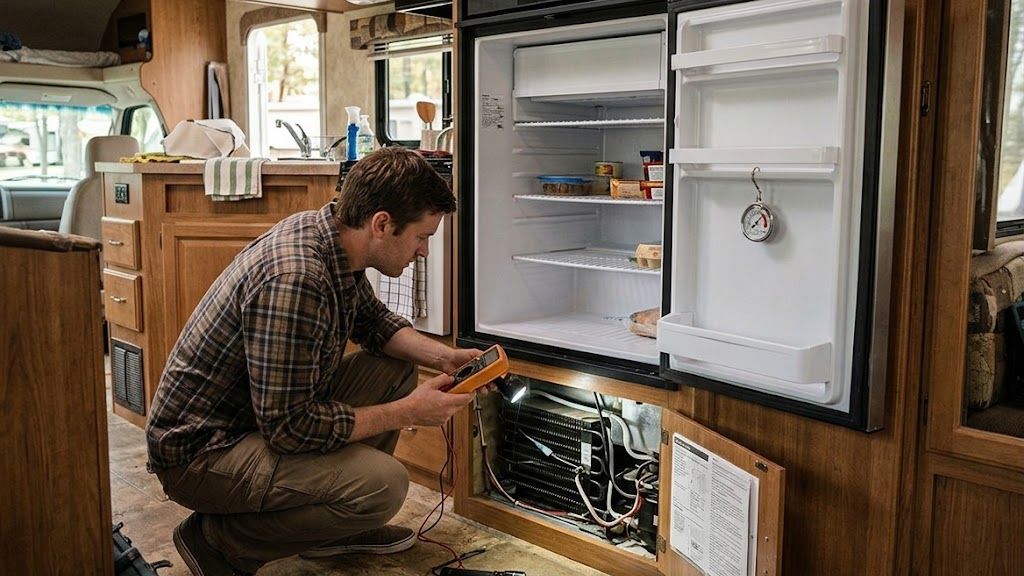
If you own a multimeter and are comfortable using it safely, a few readings will tell you a great deal. Use the chart below to interpret what you find at the generator output terminals.
| Reading at the Outlet | Most Likely Meaning | Typical Next Step |
|---|---|---|
| 115 to 125 volts | Generator output is healthy | Investigate the transfer switch or coach wiring |
| Zero volts | No output being produced | Check breakers, then board and magnetism |
| 55 to 65 volts | Partial excitation or wiring fault | Inspect regulator terminals and connections |
| Below 100 volts | Regulator failing to hold output | Load test the regulator |
| Above 130 volts | Regulator has lost control | Stop use immediately to protect electronics |
| Swinging readings | Unstable regulation | Load test before running sensitive devices |
An over-voltage reading deserves particular urgency. Voltage above 130 volts damages televisions, converters, and residential refrigerators quickly, and that collateral damage often costs more than the generator repair itself. Shut the unit down rather than continuing to run it.
The Transfer Switch Nobody Suspects
Before condemning any generator component, verify that power is actually leaving the generator. The automatic transfer switch decides whether your coach draws from shore power or the generator, and when it fails the generator gets blamed for a fault it did not cause.
There are two simple tells. Start the generator without shore power connected and listen near the transfer switch, where a relay should click audibly within roughly twenty to thirty seconds. If half your outlets work and half do not, suspect the transfer switch immediately, because a generator failure kills every circuit rather than selectively half of them.
Transfer switch contacts also carry a genuine safety concern that goes beyond convenience. Pitted or loose contacts generate heat inside a sealed enclosure, and overheated transfer switches have caused coach fires. If you find scorching or a burnt smell near the enclosure, stop using the system and contact us to have the assembly inspected before running the generator again.
Why Guessing Between These Parts Gets Expensive
Both components are electrical parts, and electrical parts are almost universally non-returnable once installed. An owner who orders a control board on suspicion and finds the fault was a regulator has spent several hundred dollars with nothing to show for it. Diagnosis costs far less than a wrong replacement.
- Non-returnable parts mean every incorrect guess is money permanently spent, unlike mechanical components that can often be returned unused.
- Overlapping symptoms allow a lost-magnetism issue, a tripped breaker, and a dead board to look identical from inside the coach.
- Load testing requires equipment that most owners do not have, since a meter alone cannot reveal how a regulator behaves under real demand.
- Live voltage carries real risk, because generator output terminals remain energized whenever the engine is running.
- A wrong repair leaves the fault in place, so the original problem returns on your next trip along with a second repair bill.
A proper diagnosis also documents which components tested good, which is useful information if the unit develops another fault later. That record saves diagnostic time on any future visit. The Wizard Group provides those test results with the estimate so you can see the reasoning behind the recommendation rather than simply accepting a part number.
Frequently Asked Questions
Can I replace an RV generator voltage regulator myself?
Mechanically confident owners can perform the swap on accessible units, since the part is usually held by a few screws and a wiring plug. The harder question is confirming the regulator is genuinely the failed component before ordering it. Because these parts are rarely returnable, the diagnostic step protects your money more than the installation skill does.
How much does it cost to fix a generator that runs but makes no power?
The range is wide because the causes are wide. A tripped breaker or lost magnetism may cost only the diagnostic fee, while a voltage regulator commonly falls in the low hundreds and a control board runs higher. Establishing the cause first is what keeps the repair at the lower end of that range.
Why does my generator produce power sometimes but not others?
Intermittent output usually points to a connection problem rather than a fully failed component. Corroded terminals, loose ground, and heat-sensitive solder joints on a board all produce symptoms that come and go. These faults are best traced while the failure is actually occurring, so note the conditions when power drops.
Will a bad voltage regulator damage my RV appliances?
Yes, and this is the strongest reason not to keep running a suspect unit. Over-voltage conditions damage converters, televisions, and residential refrigerators, while sustained low voltage overheats motors in air conditioners and pumps. Shut down and diagnose rather than continuing to operate.
How do I know if the problem is my generator or my transfer switch?
Measure voltage at the generator output terminals while the engine runs. A healthy 115 to 125 volt reading there, combined with no power inside the coach, points directly at the transfer switch or coach wiring. Losing only half your circuits is another strong indicator of a transfer switch fault.
Conclusion
The distinction comes down to what your meter shows. Wrong voltage points toward the regulator, while no voltage points toward the board, the breakers, or lost magnetism, and full voltage at the generator with darkness inside the coach points at the transfer switch. Arriving at RV generator repair services in Salt Lake City with those readings already taken turns a broad electrical investigation into a targeted repair.
Electrical faults reward patience and punish assumptions, particularly when the parts involved cannot be returned. Confirming the cause before ordering anything is what separates a modest repair bill from an expensive one. To have your output properly load tested and the failed component identified with certainty, schedule an appointment with The Wizard Group and get a diagnosis backed by actual measurements.