Warning Signs You Need a Car Oil Change in Bountiful, UT Right Now
A red low oil pressure light means stop driving immediately, and it's the one warning sign that can't wait. Dirty engine oil, a ticking noise on cold start, a burnt smell, or the oil-life reminder mean you need a car oil change in Bountiful, UT within the week, not the same hour.
Every other article on this topic hands you a flat list of ten signs and treats them as equally urgent. They aren't. One of them can destroy an engine in the time it takes to finish your commute, and three of them aren't oil problems at all. Here's the triage.
| Sign | Urgency | What to do |
|---|---|---|
| Red oil pressure light (oil can symbol) | Stop now | Pull over, shut the engine off, don't restart |
| Knocking or rod-knock under acceleration | Stop now | Same. This is metal on metal |
| Oil light plus overheating gauge | Stop now | Shut down and call for a tow |
| Amber "oil life" or "change oil soon" | This week | Book service; keep driving normally |
| Dark, gritty oil on the dipstick | This week | Book service |
| Ticking on cold start that fades | This week | Book service; mention it to the tech |
| Burnt smell after a hard climb | This week | Check level first, then book |
| Blue exhaust smoke | Book a diagnosis | Not fixed by an oil change |
| Low level with clean oil | Book a diagnosis | You have a leak or consumption |
Which warning signs mean stop driving now?
Three: a red oil pressure light, an engine knock under load, and an oil warning paired with a rising temperature gauge. All three mean parts are running without adequate lubrication, and the damage clock is measured in minutes.
The red light matters most because it's the one people misread. Volkswagen's own warning-light guidance is blunt about it — when the red engine oil pressure lamp comes on, switch off the engine immediately and do not restart, then check the oil level. Every manufacturer says a version of this. It is not a suggestion to finish your errand.
Here's the distinction that actually protects your engine: the red oil can symbol and the amber "change oil soon" message are completely different warnings. The red one says oil isn't reaching your bearings right now. The amber one says a mileage counter has expired. Drivers treat them as the same nag, and that misunderstanding is how a $110 service becomes a $6,000 engine.
If the light comes on and the oil level turns out to be fine, don't top it up and carry on. A normal level with no pressure points at the pump, a clogged pickup screen, or a failed sensor, and only one of those is harmless. That's a tow and a diagnosis, not a driveway fix.
Which signs mean book service this week?
The ones where the oil is worn out but still doing its job. You have days, not minutes, and normal driving in the meantime is fine.
What does dirty engine oil actually look like?
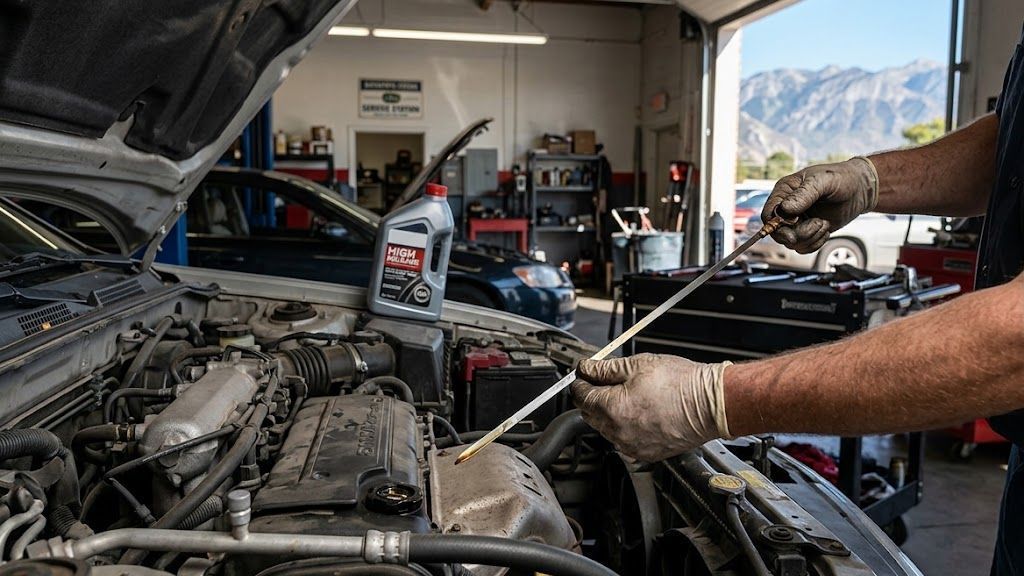
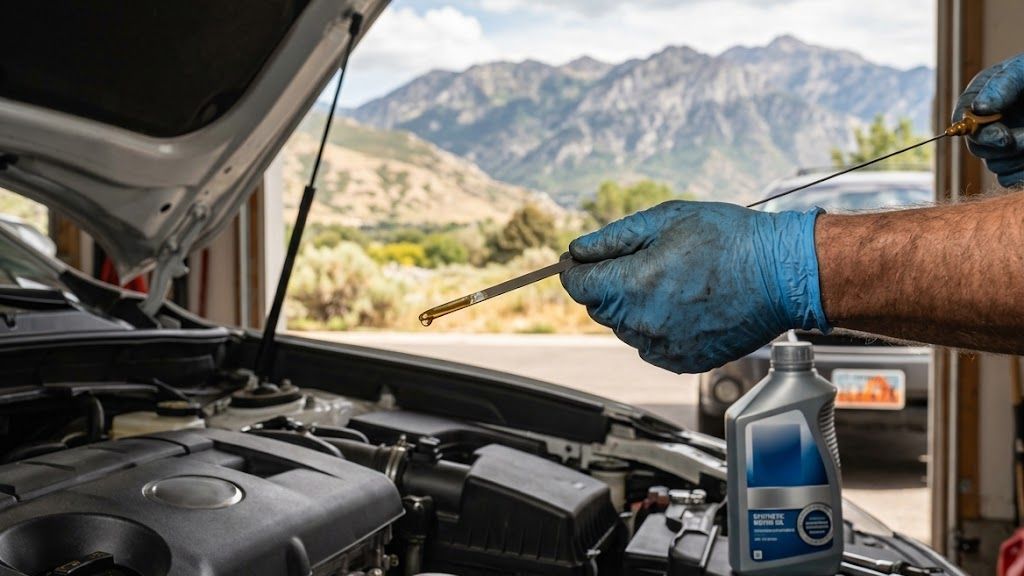
Fresh oil is amber and translucent. As it works, it collects combustion byproducts and metal particles and goes progressively darker. The practical test from the lubrication trade: pull the dipstick, and if you can't see the dipstick through the oil film, it's time.
Two clarifications, because this sign gets over-read. Dark oil is not automatically bad oil — diesel oil turns black within a few hundred miles by design, and that's the detergent package doing exactly what it should. What you're looking for is grit. Rub a drop between finger and thumb. Smooth means it's still lubricating. Gritty means abrasive particles are circulating through your bearings.
Why does a ticking noise on cold start matter?
Because it's the sound of valvetrain components running dry for a second longer than they should. Degraded oil drains back into the pan overnight and takes longer to pump on startup.
A brief tick on a 15°F Bountiful morning that fades within a few seconds is worth mentioning at your next service. A tick that lasts longer than ten seconds, or that persists once warm, moves up the list. Combined with a burnt smell after climbing a grade, it's a strong signal the oil has lost viscosity under heat and isn't recovering.
The oil-life reminder belongs in this tier too. Modern monitors estimate degradation from engine temperature, RPM, and start-stop counts, so when one fires early it usually means your driving has been harder than average — which in this county it probably has. Set up a service schedule that fits your driving and the reminder stops being a surprise.
Which symptoms are not about your oil?
Three of the signs on every competing list. Changing the oil won't fix them, and doing so can hide the real problem for another few thousand miles.
- Blue exhaust smoke. That's oil burning in the combustion chamber, which means worn valve stem seals or piston rings. Fresh oil burns just as readily as old oil. You need a compression or leak-down test, not a drain plug.
- A low level with clean oil. If you topped up 2,000 miles ago and it's low again but the oil still looks amber, the oil isn't worn out — it's leaving. That's consumption or a leak, and tracking down an oil leak at the valve cover or pan gasket is the actual repair.
- A check engine light on its own. This almost never means "change your oil." It's an emissions or sensor fault code, and it needs a scan. What a check engine light means depends entirely on the stored code, and guessing is how people replace parts they didn't need.
Persistent knocking sits in its own category. If it's still there after an oil service, you're past lubrication and into mechanical wear, which is where
signs of immediate engine trouble become the more relevant read.
What does milky oil mean in a Utah winter?
Usually condensation, not a blown head gasket — and this is the sign Bountiful drivers panic about most. A creamy, coffee-coloured film on the underside of the oil fill cap in January is often just water vapour that never got hot enough to evaporate.
The mechanism is straightforward. Combustion produces water. On a properly warmed engine it boils off through the crankcase ventilation. During inversion season, when the valley sits below freezing for weeks and your commute from the east bench to I-15 is a handful of minutes, the engine never reaches the temperature that clears it. The moisture condenses under the cap, which is the coldest metal in the system.
How to tell which one you have:
- Cap only, dipstick clean, coolant level steady. Condensation. An oil change plus a few longer drives at highway speed generally clears it.
- Milky on the dipstick too, or coolant dropping, or white sweet-smelling exhaust. That's coolant entering the oil. Stop driving and get it looked at, because running an engine on emulsified oil ruins bearings fast. That's cooling system repair territory, and possibly a head gasket.
The honest caveat: a cap-only film in July is not condensation and deserves a real look. Seasonality is most of the diagnosis here.
What does ignoring these signs actually cost?
Between nothing and an engine, depending on which sign you ignored and for how long. This is where most articles either shrug or catastrophize.
Running 1,000 miles past a reminder on healthy synthetic costs you nothing measurable. Modern oil has enough additive reserve to absorb that, and pretending otherwise is a sales tactic.
Running on genuinely spent, gritty oil for a full extra interval is different. Additives deplete, contaminants stop staying suspended, deposits build in the oil galleries, and flow drops where the tolerances are tightest — turbo bearings, timing chain tensioners, camshaft journals. AAA's testing found synthetic outperformed conventional by 47% in industry-standard tests, with the widest margins under exactly the conditions this county produces: turbocharged engines, towing, and temperature extremes. Better oil buys you margin. It doesn't buy you permission to skip the service.
And driving with a red oil pressure light is in a category by itself. Bearings can be destroyed in under a minute. Whatever the tow costs, it's a rounding error against engine diagnostics and repair on a seized motor.
How do you check your oil properly?
Six steps, two minutes, and most people get step two wrong:
- Park level and shut the engine off. A slope throws the reading by a surprising margin.
- Wait five to ten minutes. Oil needs to drain back to the pan. Checking immediately after shutdown reads low; checking stone cold on some modern engines reads high.
- Pull the dipstick, wipe it, reinsert fully, pull again. The first pull is always contaminated by splash.
- Read the level against the hatched zone. Anywhere inside it is fine. Below the low mark, add half a quart and re-check — don't dump in a full one.
- Look at the colour, then feel it. Amber and smooth is healthy. Opaque and gritty means book service.
- Check the fill cap underside while you're there. That's where condensation shows up first.
Do this monthly, and once more before any long climb or towing trip. If you'd rather not, a mobile oil change in Davis County includes the inspection anyway, which is most of the value of paying someone else.
Frequently asked questions
What's the difference between the oil light and the oil change light?
The red oil can symbol is a pressure warning: oil isn't reaching engine components, so stop and shut down. The amber "oil life" or "change oil soon" message is a mileage reminder with no immediate danger. Confusing the two is the most expensive mistake on this list.
Can I keep driving with the low oil pressure light on?
No. Manufacturers instruct you to switch off the engine immediately and not restart it. Bearing damage can begin within a minute, and there's no safe distance. If the oil level reads normal, the fault is the pump, pickup, or sensor, and the correct move is a tow.
Is dark oil always a sign it needs changing?
No. Oil darkens as its detergents suspend combustion byproducts, which is the additive package working correctly. Diesel oil goes black within a few hundred miles by design. Judge it by texture rather than shade: smooth still lubricates, gritty does not.
How long can I drive after the oil change light comes on?
A few hundred miles is fine on synthetic, and most reminders fire with margin built in. Treat it as a two-week deadline rather than an emergency. Do not stack it, though — repeatedly running an extra thousand miles past every reminder compounds into real wear.
Why does my car tick when I start it on cold mornings?
Cold oil is thicker and takes a moment longer to reach the valvetrain, so a brief tick that fades within seconds is common below freezing. A tick lasting more than ten seconds, or one that continues once warm, suggests degraded oil or a worn component and deserves a look.
Does milky residue on the oil cap mean a blown head gasket?
Not usually, especially in winter. Short cold trips leave condensation under the cap because the engine never gets hot enough to evaporate it. It becomes serious when the dipstick is also milky, the coolant level drops, or the exhaust smokes white. Then it's coolant intrusion.
Will an oil change fix blue smoke from my exhaust?
No. Blue smoke means oil is entering the combustion chamber past worn valve stem seals or piston rings, and fresh oil burns in exactly the same way. You need a compression or leak-down test to find the source. An oil change here treats the symptom and hides the cause.
Conclusion
The whole list comes down to one distinction: the red oil can means stop and shut down, and the amber reminder means book service this week. Learn to tell them apart, judge oil by texture rather than color, and remember that blue smoke, a clean-but-low level, and a standalone check engine light are different problems an oil change will only mask. Check your dipstick monthly on level ground, glance at the fill cap while you're there, and don't stack extra thousands of miles past every reminder. Wizard's Automotive & RV can read what your oil and your symptoms are actually telling you and sort the urgent from the routine. Schedule a consultation with Wizard's Automotive & RV before a warning light turns into a repair bill.