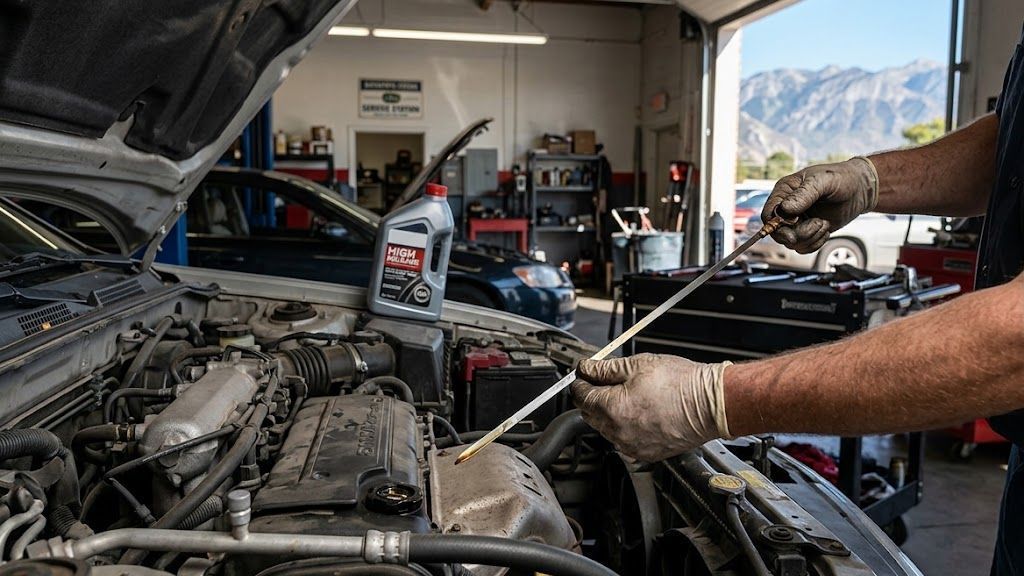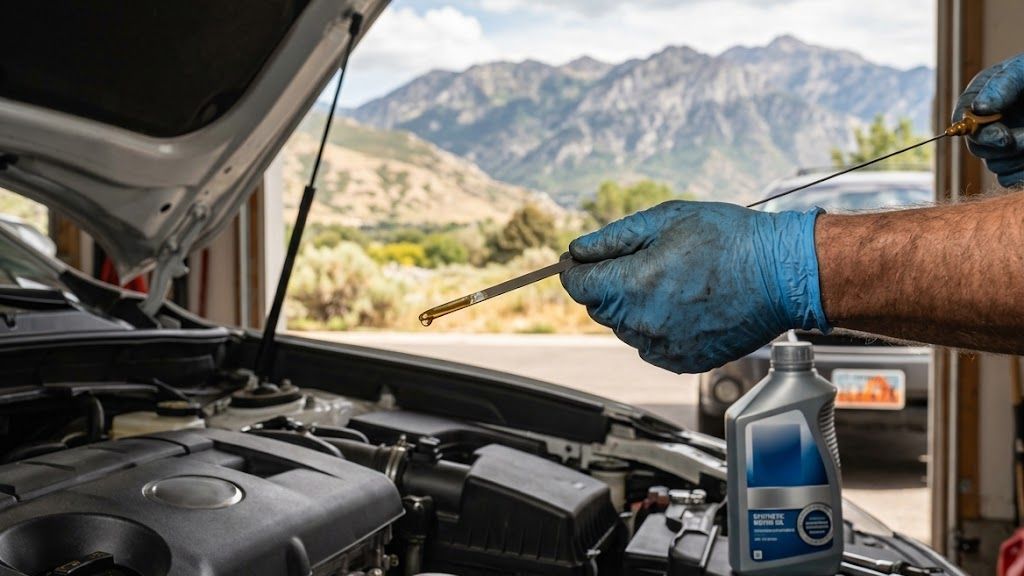
5W-30 or 5W-20? Choosing the Right Oil for Your Car Oil Change in Bountiful, UT
Use the grade printed on your oil filler cap and in the owner's manual. For a car oil change in Bountiful, UT that usually means 5W-20 on post-2000 Fords and Hondas, and 5W-30 on many GM and older engines. Both share a cold rating; only high-temperature thickness differs.
What do the numbers in 5W-30 mean?
Two separate measurements, not one. The first number with the W is a cold-start rating; the second is how thick the oil stays once the engine is hot. They're graded independently, which is why 5W-20 and 5W-30 behave identically on a February morning and differently on I-15 in July.
Castrol's explanation is the clean one: the W stands for winter, and the lower the number, the faster the oil will flow at vehicle start up. For the second number, lower means thinner at operating temperature and faster circulation through the engine.
| 5W-20 oil weight | 5W-30 motor oil | |
|---|---|---|
| Cold-start rating | 5W — identical | 5W — identical |
| Thickness at 212°F | Thinner | Thicker |
| Typical application | Post-2000 Ford, Honda, Mazda four-cylinders | Many GM engines, older designs, some turbos |
| Fuel economy | Slightly better | Slightly worse |
| Film strength under heavy load | Lower | Higher |
| Flow through tight oil passages | Faster | Slower |
One correction worth making early, because it drives a lot of bad decisions: a higher second number is not a better oil. These are classification grades, not quality scores. A 5W-30 in an engine designed around 5W-20 isn't "extra protection." It's the wrong spec.
Which oil weight does your engine take?
Three places, and they should all agree. Check the oil filler cap first — most manufacturers stamp the grade directly on it. Then the owner's manual maintenance section. On many newer vehicles the infotainment screen lists it under vehicle information.
If those three disagree, the manual wins. Aftermarket caps get swapped, and a previous owner's replacement cap tells you nothing about your engine.
California's recycling agency makes the same point about intervals that applies just as strongly to grade — they publish ranges but decline to name a number for any specific vehicle, directing drivers to the owner's manual instead. That's the correct answer here too, and it's why this article won't tell you which grade your car takes. Only your manual knows.
Rough guide to what you'll probably find. Ford has specified 5W-20 across most of its Modular V8s and four-cylinders since the early 2000s. Honda and Mazda went the same direction. GM leaned 5W-30 for years before moving much of its lineup to 0W-20. Anything from the 1990s or earlier is likely 5W-30 or 10W-30 by design.
Can you use 5W-30 instead of 5W-20?
Occasionally and briefly, yes. As a standing choice, no — and the risk isn't symmetric, which is the part most comparisons get wrong.
Going thicker (5W-20 engine, 5W-30 oil) costs you a little fuel economy, slows flow through narrow passages, and can interfere with systems calibrated for thinner oil. Annoying, occasionally expensive, rarely catastrophic.
Going thinner (5W-30 engine, 5W-20 oil) is the direction that hurts. Bearings sized for a 30-weight film get a thinner one, and under sustained load — towing, a long grade — the film can shear and oil pressure drops. That's the swap that ends engines.
So if you're stuck at a parts counter with the wrong bottle, the thicker one is the safer emergency choice. Neither is a plan.
What happens to variable valve timing?
This is the modern wrinkle, and it's why the old "thicker is safer" instinct doesn't transfer cleanly. Most engines built in the last twenty years vary cam timing hydraulically, using oil pressure routed through narrow passages in the cam phasers. Those passages are sized around a specific viscosity.
Run oil that's thicker than designed and the phasers can respond sluggishly or fail to reach commanded position. The result is usually a stored timing-correlation code rather than mechanical damage — but a rough idle, a mileage drop, or a stored fault code after an oil change is a genuine possibility, and it's a well-worn topic on Ford forums specifically. If the symptoms persist after going back to the correct grade, VVT solenoid problems are the next thing to rule out.
Does the wrong grade void your warranty?
Not automatically, but it hands the manufacturer an argument. Warranty denials on engine claims typically hinge on whether you can show the specified oil and schedule were followed. If your records show 5W-30 in a 5W-20 engine and the failure is lubrication-related, expect a fight you'll probably lose.
Keep dated receipts that name the grade. That's the whole defence.
When is 5W-30 motor oil the better call?
When your manual says so, and in one narrow case where it doesn't. Both matter less often than the internet suggests.
The legitimate uses:
- Your manual specifies it. Most GM engines through the 2010s, plenty of European applications, most older designs.
- The manual lists it as an alternate for high ambient temperatures or towing. Some do. Read the fine print before assuming.
- A high-mileage engine with measurable oil consumption, where a technician has looked at it and recommended stepping up. Worn bearing clearances can genuinely favour a slightly heavier film.
That last one is the only situation where deviating from the placard is defensible, and it needs a person who has inspected your engine — not a forum post. If the consumption is actually a leak rather than burning, thicker oil masks it briefly and fixes nothing. Engine wear and repair work should follow a diagnosis, not a viscosity guess.
Diesel owners can ignore this whole comparison. Heavy-duty diesel oils run on a separate specification with grades like 15W-40 and 5W-40 and their own API rating system, so
diesel engine servicing doesn't map onto the passenger-car grades at all.
Does Utah weather change the right oil weight?
Less than you'd think, and here's the contrarian part: the number people argue about is the one that matters least in a Bountiful winter.
Both grades are 5W. Identical cold-start behaviour. On a 15°F January morning, a 5W-20 and a 5W-30 pump at the same rate, because the second number only describes viscosity at full operating temperature — roughly 212°F — and a four-mile run from the east bench down to I-15 barely gets the oil past lukewarm. For a short-trip winter commuter, the 30-versus-20 debate is close to academic.
What would actually improve cold-start protection is a lower first number. A 0W-20 flows measurably better at startup than a 5W-20, which is exactly why manufacturers have been migrating to 0W grades. If your manual lists 0W-20 as an approved alternate to 5W-20 — many Ford and Honda manuals do — that's the upgrade worth making for inversion season, and it's a genuinely better answer than fussing over the second digit.
Summer inverts the picture. Towing a trailer up Parleys in ninety-five degree heat is where the high-temperature number earns its keep, because that's sustained high load with oil temperatures well above normal. If your manual offers 5W-30 as a towing or high-ambient alternate, summer is when to take it.
The oil's base stock matters more than either number under those conditions. AAA's testing found synthetic outperformed conventional by 47%, with the widest gaps in turbocharged engines, towing, and temperature extremes — so if you're optimising anything, start with the synthetic and conventional question rather than the viscosity digit.
How do you confirm the right grade?
Five steps, and the first two settle it for most people:
- Read the oil filler cap. Grade is usually moulded or printed right on it.
- Cross-check the owner's manual. Look for a viscosity chart — some manuals list an approved range by ambient temperature rather than a single grade.
- Check for an approved alternate. If 0W-20 is listed alongside 5W-20, take the 0W for winter.
- Confirm the API service category too. Grade is only half the spec; the oil also needs a current API licence. Both appear on the bottle.
- Tell whoever changes your oil. Say the grade out loud at drop-off, and check the sticker before you leave. Quick-lube upsells and stocking gaps are the two most common ways the wrong oil ends up in a sump.
That last step catches more errors than the other four combined. Book the right oil weight for your car by naming the grade when you schedule, and the shop can confirm they stock it before you're standing at the counter. If you're new to keeping records on a vehicle,
routine maintenance in Bountiful is worth a read for what else belongs in the file.
Frequently Asked Questions
Is 5W-30 thicker than 5W-20?
Only when hot. Both carry the same 5W cold-start rating, so they flow identically at startup. The second number describes viscosity at operating temperature, where 5W-30 stays thicker. That difference shows up under sustained load and heat, not on a cold February morning.
Can I mix 5W-20 and 5W-30 in the same engine?
Without damage, yes. They're chemically compatible, and topping up with the wrong grade beats running low. The resulting blend lands somewhere between the two, so treat it as temporary and return to the specified grade at your next service rather than making it a habit.
Will 5W-30 improve protection in a 5W-20 engine?
No, and that's the most common misconception here. Viscosity grades are specifications, not quality tiers. An engine designed around 5W-20 has oil passages and bearing clearances sized for it, so thicker oil flows more slowly to the places that need it most.
Does using 5W-30 hurt fuel economy?
Slightly, in an engine specified for 5W-20. Thicker oil takes marginally more energy to pump and creates more internal drag. The effect is real but small — typically a fraction of a mile per gallon, most noticeable in cold weather and stop-start driving rather than on the highway.
Why do manufacturers keep going thinner?
Fuel economy regulations and tighter engine tolerances. Modern engines have narrower oil galleries and closer clearances, so thinner oil reaches critical components faster. Castrol notes that lower-viscosity grades suit engines with smaller internal pathways, which is most of what's been built in the last fifteen years.
What if my manual lists two acceptable grades?
Then either is genuinely fine, and the tiebreaker is your driving. Take the thinner grade for cold-weather short trips and better mileage. Take the thicker one for towing, sustained mountain grades, or summer heat. Manuals that list a range usually chart it against ambient temperature.
Can the wrong oil weight trigger a check engine light?
It can. Engines with variable valve timing route oil through narrow phaser passages calibrated for a specific viscosity, and oil that's too thick can slow phaser response enough to set a timing-correlation code. Returning to the specified grade usually clears it; if not, a solenoid may be at fault.
Conclusion
The grade question settles itself the moment your filler cap and your manual agree, and viscosity numbers are specifications rather than quality tiers, so thicker is not safer in an engine built around thinner oil. If you want a real cold-weather improvement for inversion season, look at a 0W first number instead of arguing over the second digit, and only if your manual already approves it. Say the grade out loud at drop-off and check the sticker before you leave, since that single habit prevents most wrong-oil mistakes. Wizard's Automotive & RV can confirm the correct grade and API spec for your vehicle and stock it before you arrive. Schedule a consultation with Wizard's Automotive & RV to get the right oil in the sump and a record that proves it.