Synthetic Blend or Full Synthetic? Choosing Your Car Oil Change in Bountiful, UT
Full synthetic is worth the upgrade for most drivers, because the price gap has narrowed to roughly $8 to $15 a change while the drain interval nearly doubles. Before your car oil change in Bountiful, UT, know that no standard defines synthetic blend oil; the synthetic content is undisclosed.
What is actually in each oil?
Different base stocks, mixed in undisclosed proportions. Conventional oil is refined crude. Full synthetic is built from heavily processed or lab-built base stocks. A blend is some of each, and the ratio is the manufacturer's business, not yours.
The industry sorts base oils into five groups, and ExxonMobil's basestocks reference lays out the criteria: Group I is solvent-refined crude, Group II is hydrogen-processed with at least 90% saturates, Group III is hydrogen-processed with a viscosity index of 120 or higher, and Group IV is polyalphaolefins — genuinely synthesised molecules. Group V covers esters and everything else.
Here's the part that surprises people: most oil sold as "full synthetic" in the US is Group III, not Group IV. It's a highly processed petroleum product rather than a lab-built one, and that's legal and generally fine — Group III performs close to PAO for a fraction of the cost. But it means "synthetic" describes a performance tier, not a chemistry.
The base stocks tell that story. A synthetic blend runs on Group II with some Group III mixed in, and brands don't disclose how much — the synthetic content varies by manufacturer. Full synthetic is mostly Group III, sometimes Group IV, with no blend ratio to disclose.
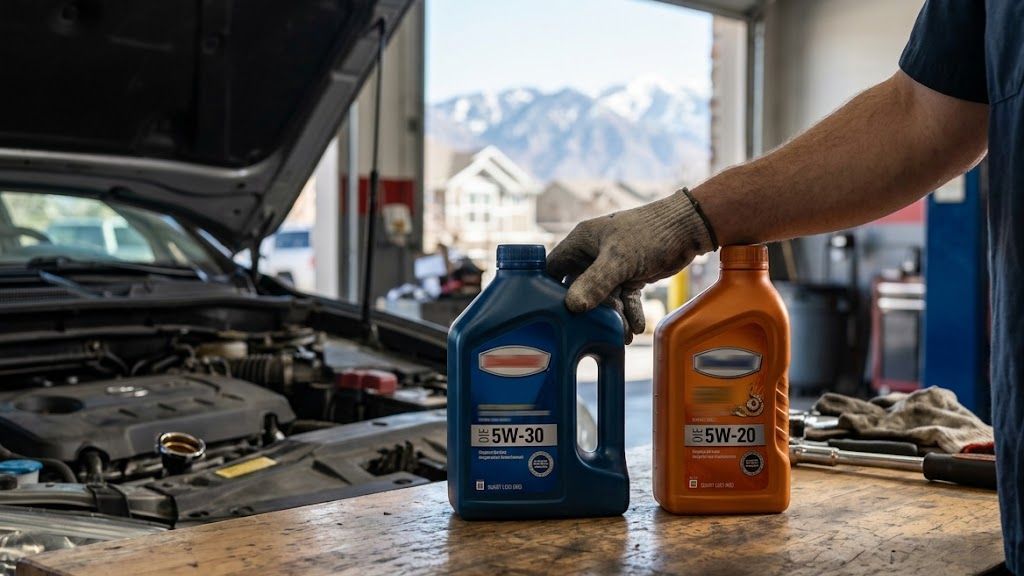
Performance splits the way you'd expect. Blends carry a 5,000–7,500 mile interval against 7,500–10,000 for full synthetic. Cold-start flow is better than conventional on a blend but best on full synthetic, and high-heat stability is moderate versus strong.
Cost and availability close the gap somewhat. A five-quart jug of blend runs about $20–24 against roughly $27–32 for full synthetic. The bigger constraint is viscosity: 0W-20 and 0W-16 are rare in blends and standard in full synthetic, so newer engines often have no real choice.
How much synthetic is actually in a blend?
Nobody will tell you, and no rule requires them to. This is the single most important fact about the product and it's buried or missing from almost every comparison article.
The terms "synthetic," "semi-synthetic," and "synthetic blend" do not appear in API's engine oil documentation as defined categories. API defines base oil groups — the Group I through V system above — and it licenses finished oils against performance standards. It does not define what proportion of Group III makes a bottle a "blend."
The practical consequence is that one brand's blend might be 30% synthetic and another's 10%, and both labels read identically on the shelf. Estimates circulating among people who test oil for a hobby range from single digits to around 30%. Nobody outside the blending plant knows, and the bottle won't say.
That's not an accusation of fraud. Blends are real products that outperform conventional oil, and the finished oil still has to pass the same API licensing tests. But it does mean you're buying an unspecified quantity of the thing you're paying extra for, which is a strange position to be in when the fully specified option costs a few dollars more.
Full synthetic at least tells you what tier you bought. That's the honest argument for the upgrade, and it's a different argument from the performance one.
Does the full synthetic upgrade cost much more?
About $8 to $15 more per oil change at current prices, or roughly $7 a jug at the parts counter. The gap is smaller than most people assume and it has been closing for years.
Per mile, the two are nearly level. A blend at $22 running 6,000 miles and a full synthetic at $29 running 9,000 miles land within a few cents of each other over a thousand miles. Almost every honest cost analysis reaches the same place: the per-jug difference looks meaningful and the per-mile difference doesn't.
Two things complicate that in 2026. First, Group III base oil supply tightened this year following disruptions in the Middle East, pushing synthetic prices up. Second — and this is the part that gets missed — blends contain Group III too, so their price moved as well. The squeeze compressed both, not just the premium tier. Anyone downgrading to a blend to escape 2026 pricing is escaping less of it than they think.
Shop pricing follows a similar pattern, though the spread is wider because labour dominates. Check what the upgrade costs at whatever shop you're comparing before assuming the blend line on the menu board is the economical choice.
Where does synthetic blend oil fall short?
At the two extremes — hard cold and sustained heat — because that's where the conventional fraction sets the ceiling. A blend performs like a weighted average of its parts, and the weakest part does the limiting.
Cold start is where this matters most in Bountiful. During the inversion season the valley holds sub-freezing air for weeks, and a blend thickens more at those temperatures than a full synthetic does. Since most engine wear happens in the seconds before oil reaches the top of the engine, that's the least convenient place to accept a compromise. The specific weakness of blend oil lines up precisely with the specific condition Wasatch Front drivers face four months a year.
The other extreme arrives in July. AAA's testing found synthetic outperformed conventional by an average of 47% across industry-standard tests, with the widest margins in turbocharged engines, towing, and temperature extremes. A blend captures part of that margin, proportional to its undisclosed synthetic content. If you're towing a trailer up a grade in ninety-five degree heat, "part of the margin, we won't say how much" is a thin thing to rely on.
There's a third limitation that ends the debate outright for a lot of cars. Blends are rarely available in the ultra-thin grades modern engines require, so if your manual specifies 0W-20 or 0W-16 the blend option mostly doesn't exist. That's the same constraint that governs the broader conventional versus synthetic decision.
Who should stay on a synthetic blend?
Drivers with older engines, mild use, and a manual that permits it. The band is narrower than it was a decade ago, but it's real, and pretending otherwise would be dishonest.
A blend is a reasonable choice when all of these hold:
- Your manual specifies 5W-30 or thicker, and doesn't require full synthetic
- The engine is naturally aspirated, with no turbo and no direct injection
- You drive moderate mileage without towing or sustained grades
- You're changing oil on the shorter 5,000-mile schedule regardless
There's also a specific case worth naming: high-mileage blends. These carry seal conditioners at a lower price than full-synthetic high-mileage oils, and for an aging engine with a genuine seep, the seal conditioner is doing more useful work than the base stock upgrade would. That's the one situation where choosing a blend over full synthetic is an affirmative decision rather than a compromise.
And if you drive very little, the base stock barely matters. A car covering 4,000 miles a year hits its twelve-month time limit long before either oil is chemically tired, which makes
how often you'll be back the deciding factor rather than what's in the bottle.
How do you decide in four steps?
- Check what the manual requires. If it specifies full synthetic or a 0W grade, there's no decision to make. Manufacturers do not list "blend" as an approved category.
- Count your severe-service conditions. Winter short trips, towing, mountain grades, a turbo. Two or more and the blend's undisclosed margin isn't a sensible thing to lean on.
- Do the annual math, not the per-visit math. Multiply price by changes per year, not by visit. A blend at 6,000-mile intervals and a full synthetic at 9,000 usually land within $20 a year of each other.
- Decide whether you'll actually use the longer interval. Full synthetic's main advantage is drain life. If you change oil every 5,000 miles out of habit regardless, you're paying for a capability you're discarding — that's the strongest honest case for a blend.
Diesel and RV owners can set most of this aside. Heavy-duty diesel oils run on separate API categories, so
diesel oil specifications don't map onto the passenger-car blend-versus-synthetic framing, and motorhome oil changes follow chassis-specific requirements that usually settle the question for you.
Frequently Asked Questions
Is synthetic blend better than conventional oil?
Yes, measurably. Blends resist heat and oxidation better than straight conventional and generally carry a longer drain interval, typically 5,000 to 7,500 miles against conventional's 3,000 to 5,000. How much better depends on the undisclosed synthetic content, which varies between brands.
Can I switch from synthetic blend to full synthetic?
Yes, at any point and any mileage, without a flush or a transition period. The two are chemically compatible. The only thing to adjust is your interval — don't stretch to full synthetic mileage until you've actually been running full synthetic for a complete change.
Is synthetic blend a marketing gimmick?
Not exactly, but the label is unregulated. The oil genuinely outperforms conventional and passes the same API licensing tests. What's missing is disclosure: no rule requires the bottle to state the synthetic percentage, so identical-looking blends can differ substantially in composition.
Does full synthetic really last twice as long?
Close to it under normal service — roughly 7,500 to 10,000 miles against a blend's 5,000 to 7,500. Utah's severe-service conditions compress both figures. Short winter trips and mountain towing pull full synthetic down toward 5,000 to 7,500, which narrows the advantage considerably.
Will full synthetic clean out my older engine?
It will clean gradually, and that's usually good. Its stronger detergent package lifts deposits of conventional oil left behind. On a neglected engine, removing deposits that were partially blocking a worn seal can make an existing leak visible. The leak was already there; the oil revealed it.
Is expensive full synthetic better than store-brand?
Rarely enough to matter. Any oil carrying the correct API licence and viscosity grade meets your engine's requirement, and store-brand full synthetic is held to the same standard. Extended-drain formulations genuinely last longer, but only benefit you if you run the longer interval.
Does my warranty accept synthetic blends?
Only if your manual permits it. Manufacturers specify a viscosity grade and an API service category, not a marketing tier, so a blend meeting both is generally acceptable. If the manual explicitly requires full synthetic, a blend puts you outside the specification — keep receipts either way.
Conclusion
For most Bountiful drivers the upgrade to full synthetic is worth making, less because of the performance gap than because you actually know what tier you bought — no rule requires a blend to disclose how much synthetic is in it. Check the oil cap first, since a 0W-20 or 0W-16 spec settles the question before you start. If you're genuinely choosing, the honest tiebreaker is whether you'll use the longer drain interval; a driver who changes oil every 5,000 miles by habit is paying for a capability they're discarding, and a high-mileage blend with seal conditioners can be the better buy for an aging engine. Wizard's Automotive & RV will tell you which grade and tier goes in your engine and why. Schedule a consultation with Wizard's Automotive & RV to match the oil to how you actually drive.