Does High-Mileage Oil Really Help? What to Know Before Your Car Oil Change in Bountiful, UT
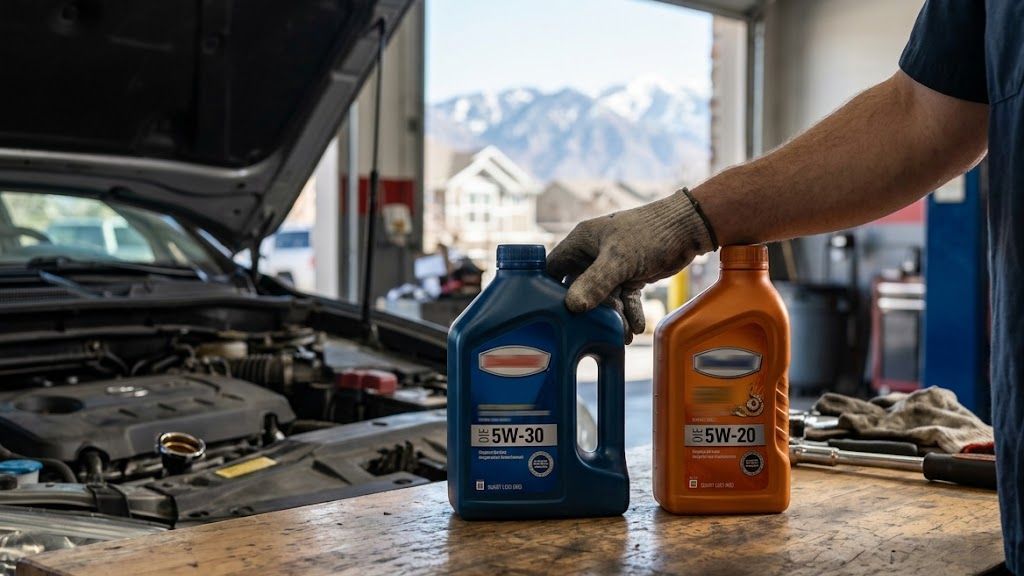
High mileage motor oil helps engines that are leaking or burning oil from hardened seals, and does little for engines that aren't. Before booking a car oil change in Bountiful, UT, judge by symptoms rather than the odometer. Nothing changes mechanically at 100,000 miles; that number is marketing.
What is high mileage motor oil?
Ordinary motor oil with a modified additive package — chiefly seal conditioners, plus extra detergents and antioxidants. The base stock is the same. It is not a different category of lubricant, and the premium over standard oil is usually a few dollars a jug.
What do seal conditioners actually do?
They swell rubber. Engine seals and gaskets are elastomers, and over years of heat cycling they lose plasticisers, harden, and shrink slightly. A shrunken seal stops sealing, which is where weeps and seeps come from.
Seal conditioners are polar compounds that get absorbed into that rubber and restore some flexibility and volume. Valvoline's technical director described the mechanism to AutoGuide as the additives reacting with elastomers to replace what the seal has lost — closer to conditioning dried leather than to applying a sealant. The same piece notes that where it works, "usually after two oil changes the leaking will be gone."
That's a real, specific chemical mechanism working on a real, specific failure mode. Hold onto how narrow it is, because the marketing does not.
Does high mileage oil help an engine over 100k miles?
Only if that engine has the problem it treats. A 130,000-mile Accord with a dry engine bay, no consumption, and clean records gains almost nothing. A 90,000-mile truck dripping from the valve cover and down a quart between changes is exactly the intended customer.
The useful question isn't your mileage. It's what your engine is doing.
| Symptom | Does high-mileage oil help? | What it needs |
|---|---|---|
| Small seep at valve cover or pan, no drips | Yes — best case | Try it for two intervals |
| Losing 1 quart per 3,000–5,000 miles | Often | Try it, then reassess |
| Losing 1 quart per 1,000 miles | Rarely | Mechanical diagnosis |
| Active drip leaving spots on the driveway | No | Gasket replacement |
| Blue exhaust smoke on startup only | Sometimes — valve stem seals | Try it, then a leak-down test |
| Blue smoke under acceleration | No | Worn rings; oil won't touch it |
| No leak, no consumption, 150,000 miles | No | Keep doing what you're doing |
| Milky oil, coolant loss | No | Head gasket or cooling system |
Cars.com reaches the same conclusion from the other direction, advising the oil for engines showing noticeable consumption, visible external leaks, or blue-tinted exhaust rather than as routine maintenance for a healthy vehicle.
Which problems will it not fix?
Anything mechanical. Seal conditioners restore rubber that has hardened chemically. They do nothing for rubber that has torn, and nothing at all for metal.
Worn piston rings are the big one. If oil is getting past the rings into the combustion chamber, you have a wear problem in the cylinder, and no additive package reaches it. Same for a blown gasket, a cracked housing, or a failed rear main. Those want proper gasket replacement, not a different bottle.
The uncomfortable version: high-mileage oil can quiet the symptoms of a mechanical problem just enough to delay the diagnosis. Consumption drops a little, the drip slows, and the underlying wear keeps going. If you're at the point of weighing repair, rebuild, or replace, an oil change is not the decision you're making.
Is 100,000 miles the right threshold?
No. Nothing happens to an engine at 100,000 miles, or at 75,000, which is the number most bottles print. Both are marketing thresholds chosen because they're round and memorable.
Seal hardening is a function of heat cycles, time, and maintenance history — not distance. A garage-kept highway car at 140,000 miles can have seals in better shape than a short-trip commuter at 70,000 that spent every winter never reaching operating temperature. The odometer is a weak proxy for the thing that actually matters.
This is why the forum consensus among people who test oil for a hobby is blunter than the ad copy: if your car doesn't leak or burn oil, there's no reason to run high-mileage oil regardless of what the odometer says. The product was reportedly developed to address valve stem seals on a particular family of engines, and the broader benefits were discovered afterward. It's a targeted fix that got marketed as a life stage.
So treat "over 100k miles" as a prompt to look, not an instruction to buy.
Can high mileage oil cause harm?
Mildly, in one specific case that almost nobody writes about. Cars.com puts it plainly: "if you swell and soften seals that aren't leaking, you could tighten carefully calculated clearances and cause added wear to those seals."
That's the honest counterweight to a category that's usually sold as free insurance. Swelling a seal that was sealing correctly isn't a neutral act. It's a small, real downside, and it's the reason "might as well, it's only a few dollars more" is weaker reasoning than it sounds.
Two smaller cautions worth knowing:
- It can mask a leak you needed to find. A seep that stops is a seep you stop monitoring. If the underlying gasket is degrading rather than merely dry, you've bought quiet, not a repair.
- Switching to any stronger detergent package can reveal an existing leak. AAA notes that synthetic will not damage your high-mileage vehicle provided it's been maintained, but that cleaning away deposits can expose gasket problems those deposits were hiding. That's not the oil's fault, and it's better to know. It does mean a new leak appearing right after a switch deserves a look rather than a panic.
None of this makes high-mileage oil a bad product. It makes it a specific one.
Does Utah weather age engine seals faster?
Probably, and it's the most defensible reason for a Bountiful driver to consider it earlier than the number on the jug. Elastomers age by heat cycling, and Davis County puts vehicles through an unusually wide annual swing.
Inversion season parks the valley below freezing for weeks. Summer runs into the high nineties, and a vehicle sitting on asphalt or towing a grade sees underhood temperatures well above ambient. That's a roughly hundred-degree annual range, repeated every year, and each cycle costs a seal a little flexibility.
Short trips compound it. A four-mile run from the east bench down to I-15 in January heats seals partway and then lets them cool, which is harder on rubber than reaching full temperature and holding it. The same driving pattern that shortens oil life here also ages the parts high-mileage oil is designed to treat.
The practical version: a Wasatch Front commuter may show seep-stage symptoms at 80,000 miles that a San Diego highway car wouldn't show until 130,000. That argues for watching your engine's condition on Utah's schedule rather than the bottle's, and it's the same reasoning behind treating preventative maintenance here as a condition-based exercise rather than a mileage checklist.
One honest limit: this is mechanism-based reasoning, not a published study on Utah vehicles specifically. Nobody has run that comparison. Take it as a reason to inspect sooner, not as a precise number.
How do you decide if you need it?
Four steps, and the first one takes a month:
- Measure your consumption properly. Top up to full, note the odometer, then check again in 1,000 miles. Repeat once. Under a quart per 5,000 miles is normal for most engines. A quart per 1,000 is a mechanical problem, not an oil-selection problem.
- Look under the car after it's been parked overnight. Fresh spots on concrete mean an active leak. A damp, dusty film on the engine with nothing on the ground is a seep — that's the high-mileage oil use case.
- Watch the exhaust on a cold start. A brief blue puff on startup that clears points at valve stem seals, which conditioners sometimes help. Blue smoke under acceleration points at rings, which they don't.
- If two or more point to seals, try it for two intervals. Then measure again. If consumption hasn't moved after two changes, it isn't going to, and you've learned something worth knowing before what engine work costs becomes the next conversation.
Worth separating two decisions people tend to blur. High-mileage is an additive choice;
synthetic or conventional base stock is a separate one, and you can have high-mileage versions of either. If your engine is healthy, the base stock decision matters considerably more than the high-mileage label does.
Frequently asked questions
At what mileage should I switch to high mileage oil?
There isn't one, despite what the bottle says. Switch when your engine shows symptoms — a seep, measurable consumption, or blue smoke on startup — not when the odometer hits a round number. A healthy engine at 150,000 miles gains nothing from the switch.
Will high mileage oil stop my oil leak?
Sometimes, if the seal has hardened rather than torn. Where it works, the improvement usually shows within two oil changes. An active drip leaving spots on your driveway is past that point and needs the gasket replaced. Conditioners restore dried rubber; they don't repair damaged rubber.
Can I use high mileage oil in a newer car?
You can, but there's little reason to. Seal conditioners swell elastomers, and swelling seals that are sealing correctly can tighten designed clearances and add wear. On a healthy engine under warranty, use the grade your manual specifies and skip the extra additives.
Does high mileage oil reduce oil burning?
Only when the burning comes from valve stem seals, which show up as a blue puff at cold startup that clears. Burning caused by worn piston rings produces smoke under acceleration and won't respond. Measure consumption before and after two changes to find out which you have.
Is high mileage synthetic worth the extra cost?
If you need the seal conditioners, yes — the premium over standard synthetic is small and the alternative is labour. If your engine is dry and doesn't consume oil, you're paying for an additive that has nothing to act on. Base stock matters far more.
Can I switch back to regular oil afterwards?
Yes, at any point, without harm. Seals that were conditioned may gradually return toward their previous state, so a leak that stopped could return over several intervals. If the conditioners were doing real work, that reversal is itself useful information about the seal's actual condition.
Does high mileage oil void a warranty?
Not if it meets your manufacturer's viscosity grade and API service category, which the major brands do. The additive package isn't the issue; the specification is. Check the bottle for the grade your manual requires and keep the receipt, same as with any oil.
Conclusion
High-mileage oil is a targeted fix for hardened seals, not a milestone your odometer earns, so let symptoms decide rather than a round number on a jug. Measure your consumption over a thousand miles, check the concrete under the car overnight, and watch the exhaust on a cold start; if two of those point at seals, try it for two intervals and measure again. If the engine bay is dry and nothing is disappearing, put the money into the right base stock instead, and treat a quart every thousand miles as a diagnosis rather than a shopping decision. Wizard's Automotive & RV can tell a seep from an active leak and valve stem seals from worn rings before you spend anything. Schedule a consultation with Wizard's Automotive & RV once you have your consumption number in hand.