Does Running the RV Air Conditioner Make the Engine Overheat While Towing?
You are climbing a long Utah grade with the camper behind you, the cab is finally comfortable, and then a nagging thought arrives: is the air conditioning the reason that temperature needle is creeping up? Here is the honest answer. On a healthy, properly sized tow vehicle, running the AC will not by itself overheat your engine, but it does consume a slice of your cooling reserve, and Utah road trip camper overheating usually happens when that last slice disappears on a steep climb in summer heat. The AC is almost never the root cause. It is the straw that lands on a system already carrying a weak thermostat, a dirty front stack, or more trailer than the truck was built to pull.
That distinction matters, because it changes what you should do about it. If switching off the AC solves your temperature problem, you have not fixed anything, you have simply revealed how little margin you had left. This guide explains exactly how much load the AC really adds, why the condenser's position in front of the radiator matters so much, when it is genuinely smart to shut it off, and what a rig should do if it cannot climb a Utah pass with the air on.
Does Turning Off the Air Conditioning Actually Cool the Engine Down?
Yes, and it works through two separate mechanisms at once, which is why the effect is often larger than drivers expect. Turning the AC off removes mechanical load from the engine and it removes a heat source from directly in front of your radiator. Most drivers know the first one. The second one is the part that gets overlooked.
It Removes Engine Load
Your AC compressor is belt driven, so it steals power straight off the crankshaft. Real world draw varies widely with conditions, from well under one horsepower on a mild day to as much as 10 horsepower on a hot afternoon with the blower on high. On flat ground with a 400 horsepower truck, that is noise. On a 6% grade at 7,000 feet where the engine is already producing everything it has, that same draw is a meaningful share of what is left.
It Removes Heat From the Front of the Radiator
This is the mechanism most people miss. Your air conditioning does not destroy heat, it moves heat from the cabin to the outside air, and it dumps that heat through the condenser. Manufacturers place the condenser in front of radiator cores deliberately, because the AC works best with the coldest available air, which means the air reaching your radiator has already been preheated before it touches a single cooling fin. Switch off the AC and that air arrives cooler, immediately widening the temperature gap the radiator depends on.
Both effects together explain why highway departments post those familiar signs before long western climbs advising drivers to shut off the air conditioning. It is not superstition. It is the cheapest and fastest way to hand a struggling cooling system back several degrees of capacity.
How Much Load Does the AC Compressor Really Add?
Less than most people fear, but more than nothing, and the amount is highly variable. The AC compressor engine load depends on ambient temperature, humidity, cabin temperature, blower speed, and the type of compressor your vehicle uses. A modern variable displacement compressor on a mild morning barely registers. The same unit on a 105 degree afternoon near Green River with the fan on maximum is working as hard as it ever will.
There is also a detail worth knowing about how your truck already protects you. Most vehicles built since roughly 2000 include a wide open throttle cutout that momentarily disengages the compressor when you floor the pedal. Many trucks also drop the compressor automatically when coolant temperature climbs past a threshold. Your rig is already trying to help you before you touch the dash.
| Driving Condition | Approximate AC Engine Load | Practical Effect While Towing |
|---|---|---|
| Flat highway, mild day, low fan | Under 1 horsepower | Negligible, leave the AC on |
| Flat highway, hot day, high fan | Roughly 3 to 6 horsepower | Minor, healthy systems handle it easily |
| Sustained grade, hot day, high fan | Up to about 10 horsepower | Noticeable, this is where margin gets thin |
| Grade plus preheated condenser air | Load plus reduced radiator efficiency | The combination that pushes a marginal system over |
Notice that the bottom row is not simply a bigger number. It is a different kind of problem, because load and airflow degrade together. That compounding is exactly why a truck can tow comfortably with the AC on for 300 flat miles and then struggle on a single twenty minute climb.
Why the AC Gets Blamed for Utah Road Trip Camper Overheating
The air conditioning is the last variable a driver controls, so it takes the blame for a failure that was already in progress. Most cases of the Utah road trip camper overheating trace back to a cooling system that lost its reserve capacity long before the AC was switched on, and the state's geography is unusually good at exposing that. Thin air, sustained grades, and desert heat strip away margin in three directions at once.
Elevation Thins the Air Doing the Cooling
Air density falls roughly 3% per 1,000 feet of elevation. Near the top of Parleys Canyon at about 7,050 feet, each cubic foot of air moving through your radiator and condenser carries meaningfully less heat away than it would at sea level. Your engine also makes less power up there, so you press harder to hold speed, producing more heat with less ability to shed it.
The Climbs Never Let You Recover
A short hill lets a cooling system catch its breath on the far side. Utah rarely offers that. The eastbound pull through Parleys Canyon runs a sustained 6% grade, the steepest sustained grade permitted anywhere on the Interstate system, and Spotted Wolf Pass on Interstate 70 gains close to 2,000 feet in about three miles. Soldier Summit on US-6 has a long reputation for cooking transmissions on loaded rigs.
Summer Heat Sets the Floor
A radiator can only cool coolant toward the temperature of the air passing through it, so ambient heat defines your best possible outcome. A 105 degree afternoon in the desert corridors leaves far less usable temperature difference than a 70 degree morning on the same road. Add the condenser preheating that air further and the math gets tight quickly.
What Actually Causes the Overheating When the AC Is On?
If your engine only runs hot with the air conditioning engaged, the AC is the trigger but something else is the fault. A properly maintained truck within its tow rating should climb a Utah pass with the AC running and never exceed its normal range. When it cannot, one of the following is almost always the reason.
- A clogged front stack. Bugs, cottonwood fluff, and fine desert dust pack between the condenser and radiator and act like insulation, and debris hidden between the layers is invisible from the grille.
- A lazy fan clutch or failed electric fan. Airflow at 35 mph on a grade comes almost entirely from the fan, so a clutch that will not lock up removes exactly the airflow you need most.
- A thermostat stuck partly closed. It can behave perfectly around town and fail to open fully under sustained load, which is why the symptom appears only on the first real climb.
- Low or old coolant. Less coolant carries less heat, and aged coolant loses the inhibitors that keep scale from building inside the radiator tubes.
- A weak radiator cap. Pressure is what raises the boiling point of a 50/50 mix from about 223 degrees to roughly 260 degrees, so a tired cap quietly erases your safety margin.
- A failing water pump. An eroded impeller can move enough coolant at highway speed to seem fine, then fall short under the heat load of a long pull.
- Simply too much trailer. If the load is beyond the vehicle's rated capacity, overheating with the AC on is the system telling you the truth about the pairing.
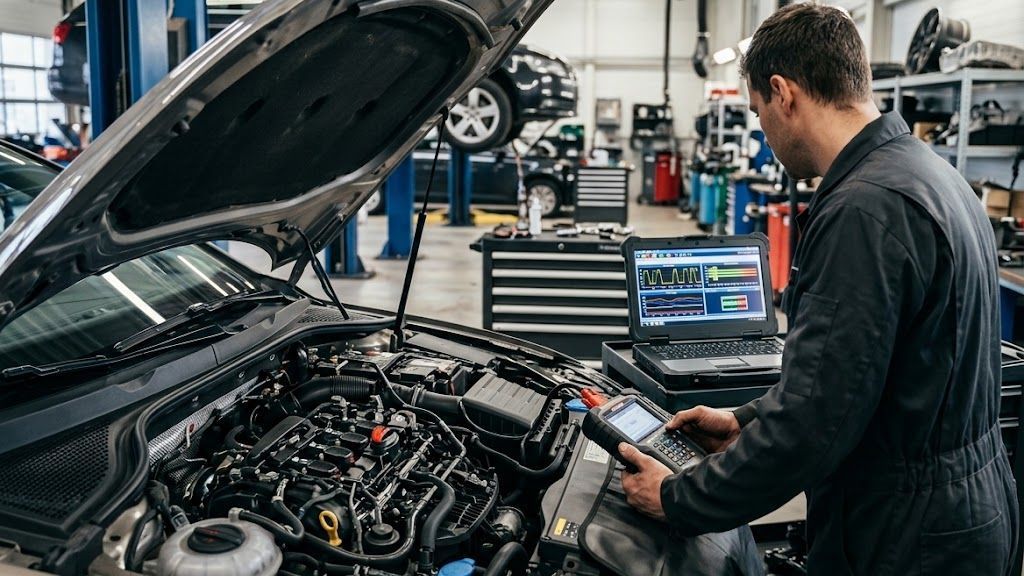
Diagnosis matters here because these failures produce nearly identical gauge readings, and swapping parts one at a time is an expensive way to guess. A shop with a pressure tester, an infrared thermometer, and a scan tool can separate them in a single afternoon. The technicians at
The Wizard Group see the same short list arrive again and again on rigs that limped off a canyon climb, and in most cases the warning signs were visible weeks earlier as a crusty condenser face or a hose that felt soft when squeezed.
When Should You Switch the AC Off While Towing?
Use the air conditioning freely under normal conditions and treat switching it off as a tool you reach for when the gauge tells you to. Comfort matters on a long drive, and a fatigued driver is its own safety problem. The practical rule is to respond to data rather than to run hot and miserable out of caution.
- Switch it off the moment the temperature gauge climbs above its normal plateau and keeps rising. This is the first and cheapest move available to you.
- Switch it off before a long known climb if your rig has a history of running warm. Prevention on the approach beats reaction halfway up.
- Switch it off when you see posted signs advising it on a steep grade. Those signs exist because that road has a track record.
- Leave it on when the gauge is steady, even if the needle sits higher than it does on flat ground. A stable elevated reading is a system working hard and winning.
- Turn the cabin heater to full if temperatures keep climbing after the AC is off. The heater core acts as a second radiator and genuinely pulls heat out of the engine.
- Slow down and downshift alongside any of the above. Lower speed cuts heat production and higher rpm speeds up both the water pump and the fan.
If the temperature returns to normal and stays there through a gentle continued climb, you found the edge of your capacity rather than a broken part. If it climbs again quickly, stop and arrange service, because an engine can be damaged in as little as 30 to 60 seconds of true overheating. Never open a radiator cap on a hot system, since coolant held above its boiling point by pressure will erupt the instant that pressure is released.
Dash Air Conditioning Versus the Rooftop Unit
These are two completely different systems and only one of them touches your engine, which is a distinction that causes real confusion among newer travelers. Mixing them up leads people to worry about the wrong thing entirely. Understanding the split makes your options clearer.
| System | What Powers It | Effect on Engine Temperature |
|---|---|---|
| Dash AC in the tow vehicle | Belt driven compressor off the engine | Adds engine load and preheats radiator air through the condenser |
| Rooftop unit on a travel trailer | Shore power or a generator, 120 volt | No mechanical load on the tow vehicle engine at all |
| Rooftop unit on a motorhome | Onboard generator while driving | Generator load only, not a belt driven draw on the drive engine |
Because a towed trailer's rooftop unit runs on its own power source, it does not contribute to tow vehicle overheating in any direct way. Travelers with a motorhome can typically run the roof air from the onboard generator while moving, though you should confirm this against your own manual since the manufacturer's guidance is the final word. Watch fuel consumption on long climbs and shut the AC off before you shut the generator down.
A portable generator strapped in a truck bed to feed a trailer's roof air is a different matter and is generally a poor idea. Securing the unit, routing the exhaust safely, and running live power lines between two moving vehicles introduces real hazards for a modest comfort gain. Most experienced haulers simply cool the trailer at the campsite instead.
How to Keep Your Cooling Margin Before You Leave
Nearly every roadside cooling failure could have been caught in a driveway inspection an hour before departure. The point of this list is not just to prevent a breakdown, it is to give you enough reserve that you never have to choose between comfort and a safe climb. An hour here is the highest value maintenance a traveler can buy.
- Rinse the condenser and radiator gently with a garden hose from the engine side outward, never with a pressure washer, since high pressure bends the delicate aluminum fins and makes airflow worse.
- Separate and inspect between the coolers if your rig has high mileage, because trapped debris in the middle of the stack is completely hidden from the front.
- Check coolant level cold at both the reservoir and the radiator, and top off with the specification your engine actually calls for.
- Pressure tests the system to catch slow leaks that only appear under load, and replace the radiator cap if it will not hold its rated pressure.
- Confirm the fan clutch engages by listening for the fan to roar during a hot idle, and confirm electric fans cycle on a warm engine.
- Have the AC refrigerant charge checked, since an overcharged or undercharged system makes the compressor work harder than it needs to.
- Verify your actual loaded weight against the vehicle's tow rating, because no amount of maintenance fixes a pairing that is over capacity.
Timing is worth thinking about too. A cooling inspection booked in spring leaves room to order a fan clutch or a radiator and still depart on schedule, while the same finding in July often means waiting on parts during peak travel season. Travelers who want that work handled before a mountain trip rather than after a breakdown can
contact us to get on the schedule early, and The Wizard Group treats the condenser and the radiator as one system during that inspection rather than checking only the part that failed.
How to Drive Utah Grades With the Air On
Technique buys you more margin than most hardware upgrades, and it costs nothing. Experienced haulers in the Intermountain West climb slower than the posted limit deliberately, because the fastest way up a grade is rarely the kindest to the drivetrain. A few habits let you keep the cabin comfortable.
- Climb at a steady 45 to 55 mph instead of fighting to hold 65, since steady moderate load produces far less heat than repeated full throttle surges.
- Use tow/haul mode on every grade, because it holds gears longer and keeps the engine where the water pump and fan move real volume.
- Downshift before the climb rather than partway up it, so the transmission is not hunting for gears under full load.
- Start early in the day. Crossing Parleys Canyon, Soldier Summit, or the San Rafael Swell before 10 a.m. can mean a 30 degree cooler ambient temperature and changes the entire equation.
- Use the pullouts. They let faster traffic by and double as a cooling break if the gauge has been creeping.
- Descend in a low gear. Engine braking protects your brakes, and brake fade on a 6% descent is every bit as dangerous as a hot engine.
Rigs that follow these habits and carry a healthy cooling system generally cross Utah with the air conditioning running the entire way. That is the goal, and it is a realistic one. The Wizard Group builds pre-trip inspections around that standard, since a camper used in the mountains has to be held to a different bar than one that only ever sees flat interstate.
Frequently Asked Questions
Is it bad to run the AC while towing a heavy trailer?
No, not on a healthy tow vehicle operating within its rated capacity. The compressor adds load and the condenser preheats the air reaching your radiator, but a properly maintained system is designed to absorb both. If your rig can only tow comfortably with the AC off, treat that as a diagnostic finding rather than a normal operating procedure.
How much horsepower does a car air conditioner use?
Real world figures range from well under 1 horsepower on a mild day at a low fan setting to roughly 10 horsepower on a hot day with the blower on maximum. The exact draw depends on ambient temperature, humidity, and whether your vehicle uses a fixed or variable displacement compressor. The number matters most when the engine is already near full output on a climb.
Why do highway signs tell you to turn off the AC on steep grades?
Because it is the single fastest way for a driver to reduce heat load without stopping. Switching the compressor off frees engine power and lowers the temperature of the air passing through the radiator, which together can recover several degrees of cooling capacity. Those signs are typically posted on roads with a documented history of vehicles overheating.
Can running the AC damage my engine on a long climb?
The AC itself will not damage a healthy engine, but ignoring a rising temperature gauge absolutely can. Warped cylinder heads and blown head gaskets come from continuing to drive through an overheat, not from the compressor. Repeated overheating cycles cause cumulative damage even when the engine still runs afterward.
Should I run the AC or open the windows while towing?
At highway speed the air conditioning is usually the better choice, since open windows create aerodynamic drag that also costs engine power and fuel. The tradeoff shifts only when you are already at the edge of your cooling capacity on a sustained grade. In that situation, closed windows with the AC off and reduced speed is the safest combination.
Conclusion
Running the RV air conditioner does not make a healthy engine overheat while towing, though it does consume part of the cooling reserve you rely on when the grade turns steep. In practice, Utah road trip camper overheating is a story about margin rather than about the AC, and the compressor simply happens to be the last thing switched on before the gauge moves. Fix the underlying weak link, whether that is a packed condenser, a lazy fan clutch, a tired thermostat, or a trailer heavier than the rating allows, and the air conditioning stops being a factor at all.
Drive with the terrain rather than against it. Climb steadily at 45 to 55, use tow/haul mode, start early in the day, and treat a rising needle as useful information instead of an annoyance. Pair those habits with an honest pre-trip inspection of your condenser, radiator, cap, coolant, and fan, and you should be able to cross Utah's most demanding passes in a cool cab without ever wondering what the temperature gauge is about to do.