What Are the Signs You Need Transmission Repair Services After Driving Bountiful's Mountain Roads?
Your transmission almost always warns you before it quits. After a season of climbing Skyline Drive, crawling up Farmington Canyon, or pulling a trailer over the bench, the clearest signs of trouble are slipping between gears, a delay when you shift into drive, a burnt odor under the hood, shuddering at steady highway speed, and reddish fluid spots on the driveway. Those symptoms rarely appear out of nowhere. They show up because mountain driving asks your gearbox to work harder than the engineers who wrote your maintenance schedule ever assumed you would. Booking auto repair services Bountiful, UT drivers can reach quickly, before the problem spreads, is the difference between a few hundred dollars in maintenance and a four-figure rebuild.
Bountiful sits right against the Wasatch Front, and that geography is a gift for weekend plans and a challenge for drivetrains. A stock vehicle leaving a driveway near 400 North can be above 9,000 feet within half an hour. That kind of climb heats transmission fluid faster than an hour of freeway cruising, and heat is the single biggest reason automatic transmissions fail early.
What Are the First Warning Signs of Transmission Trouble After Mountain Driving?
The first signs are usually changes in how the vehicle feels, not sounds you hear or lights you see. Drivers describe it as the car "hunting" for a gear, hesitating for a beat before it grabs, or revving higher than usual without picking up speed. Pay attention to those sensations in the day or two after a long climb, because that is when a stressed transmission is most likely to reveal itself.
Slipping Gears After Canyon Driving
Slipping happens when the engine RPMs rise but the vehicle does not accelerate to match. On a grade, worn clutch packs and thinned fluid cannot hold pressure, so power stops reaching the wheels cleanly. Slipping gears, canyon driving, and heat feed on each other in a loop: the slip creates friction, the friction creates more heat, and the heat degrades the fluid that was supposed to prevent the slip. Once you feel it, the internal wear has already started.
Delayed or Harsh Engagement
Shift from park into drive and count. A healthy automatic engages almost immediately. If there is a noticeable pause, or the vehicle lurches into gear with a thud, hydraulic pressure is low or a solenoid is not responding correctly. Cold mornings in Davis County can exaggerate this slightly, but a delay that persists after warm-up is a genuine fault.
A Burning Smell and Dark Fluid
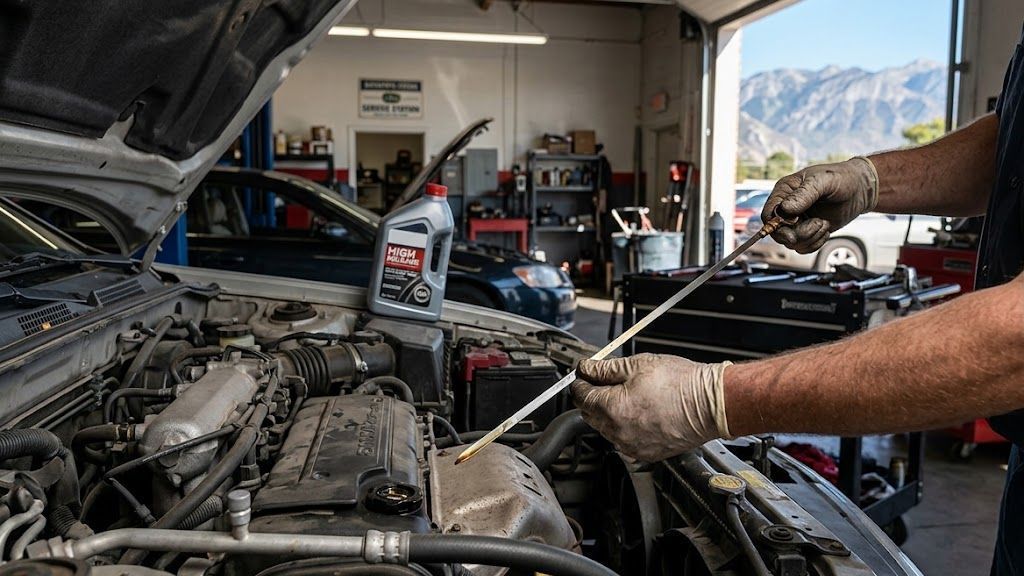
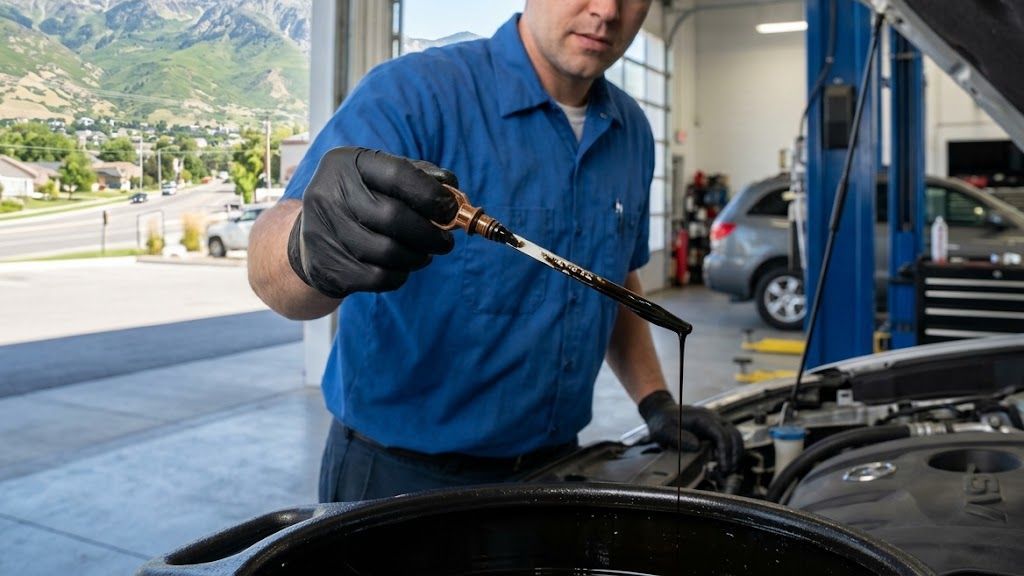
Healthy automatic transmission fluid is bright red and smells faintly sweet. Overheated fluid turns brown or near black and gives off a sharp, acrid odor similar to burnt toast. If you notice that smell after descending a canyon, the fluid has cooked and lost its ability to lubricate and cool. Most automatic transmissions are designed to run somewhere between roughly 160 and 200 degrees Fahrenheit, and fluid life drops sharply for every 20 degrees above that range.
Shudder, Vibration, and Whining
A shudder that shows up at a steady 40 to 50 miles per hour, often described as driving over rumble strips, usually points to a torque converter that is no longer locking up smoothly. Whining, humming, or a low growl that changes pitch with vehicle speed rather than engine speed suggests a bearing or pump issue. Grinding during shifts is more serious and means metal is contacting metal somewhere it should not.
Leaks and Warning Lights
Transmission fluid leaves reddish or brown spots, typically toward the middle of the vehicle rather than the front where oil collects. A check engine light or a dedicated transmission temperature light means the computer has already logged a fault code, and many modern vehicles will drop into limp mode, locking themselves into second or third gear to protect the internals.
| Symptom You Notice | What It Usually Points To | How Soon to Act |
|---|---|---|
| Engine revs, vehicle does not accelerate | Worn clutches, low or degraded fluid | Within days |
| Pause or thud shifting into drive | Low hydraulic pressure, failing solenoid | Within a week |
| Burnt smell, dark fluid | Overheated and broken down fluid | Immediately |
| Shudder at steady cruising speed | Torque converter lockup problem | Within days |
| Grinding, red puddle, or warning light | Internal damage or active fluid loss | Stop driving, get it inspected |
Why Bountiful's Canyon Roads Are Harder on Transmissions Than Flat Miles
The terrain here creates conditions that most manufacturers classify as severe service, even though very few drivers think of their daily routine that way. Skyline Drive climbs from roughly 4,500 feet to more than 9,000 feet across its run between Bountiful and Farmington. Farmington Canyon Road turns to steep, narrow dirt within the first mile and continues climbing for around nine miles to the campground. That is a sustained load with almost no recovery time.
Thinner air at elevation is part of the problem. There is simply less air available to carry heat away from the radiator and the transmission cooler, so a system that stays comfortable at valley temperatures can climb toward its limit above 7,000 feet. Add summer heat, a roof box, or a boat headed for Bear Lake, and the margin disappears entirely.
Descents are not a break either. Engine braking down a grade routes energy back through the drivetrain, and stop-and-go traffic on Bountiful Boulevard or the bench streets keeps the torque converter cycling without steady airflow to cool it. Winter adds its own layer, since cold starts to thicken fluid and road salt accelerates corrosion on cooler lines and pan gaskets. The technicians at
The Wizard Group see this pattern year after year, and the vehicles that hold up best are the ones serviced on a schedule built for mountains rather than a schedule built for flat interstate commuting.
The Heat and Fluid Life Connection
Heat is cumulative. A single trip up Ward Canyon will not destroy a transmission, but forty of them over three summers absolutely can, especially if the fluid has never been changed. Fluid does not just lubricate. It transfers heat, carries hydraulic pressure, and keeps friction material where it belongs. When it breaks down, all three jobs suffer at once, which is why a small maintenance item turns into a major repair so quickly.
What to Expect From Honest Auto Repair Services Bountiful, UT Drivers Can Trust
A proper diagnosis should always come before anyone quotes you a rebuild. Reputable auto repair services Bountiful, UT vehicle owners rely on will start with a fluid inspection, a scan for stored trouble codes, a pressure test, and a road test that actually replicates a grade rather than a lap around the block. Any shop that recommends a full replacement without performing those steps is guessing with your money.
Diagnostics Come First
A scan tool reads codes, but codes only narrow the field. Pressure testing tells a technician whether the pump and valve body are holding, and a road test under load reveals whether the slip happens in a specific gear or across the range. Many complaints that feel catastrophic turn out to be a failed solenoid, a clogged filter, a bad speed sensor, or fluid that has simply worn out.
Flush, Drain and Fill, or Rebuild
An automatic transmission fluid flush uses a machine to exchange nearly all the old fluid for new, while a drain and fill replaces roughly half and gives the technician a chance to drop the pan, inspect for debris, clean the magnet, and change the filter. For a well-maintained vehicle under about 70,000 miles, a full flush is an excellent preventive step. For a high-mileage vehicle that has never been serviced, most experienced shops prefer a drain and fill, since aggressive flushing can dislodge accumulated debris into passages that were functioning around it.
How Often Should You Schedule an Automatic Transmission Fluid Flush Here?
Follow the severe service column in your owner's manual, not the normal one. Mountain grades, towing, stop-and-go traffic, and wide temperature swings all qualify as severe conditions, and Bountiful delivers every one of them. Manufacturers commonly list 60,000 to 100,000 miles for normal use, and shops in mountain regions consistently recommend cutting that interval roughly in half.
| Your Driving Pattern | Suggested Fluid Service | Notes |
|---|---|---|
| Valley commuting only, no towing | Every 50,000 to 60,000 miles | Follow the manual baseline |
| Regular canyon trips, no trailer | Every 40,000 miles | Inspect fluid color annually |
| Towing, hauling, or frequent grades | Every 25,000 to 30,000 miles | Consider an auxiliary cooler |
| CVT or dual-clutch, any conditions | Every 30,000 miles | Requires manufacturer-specific fluid |
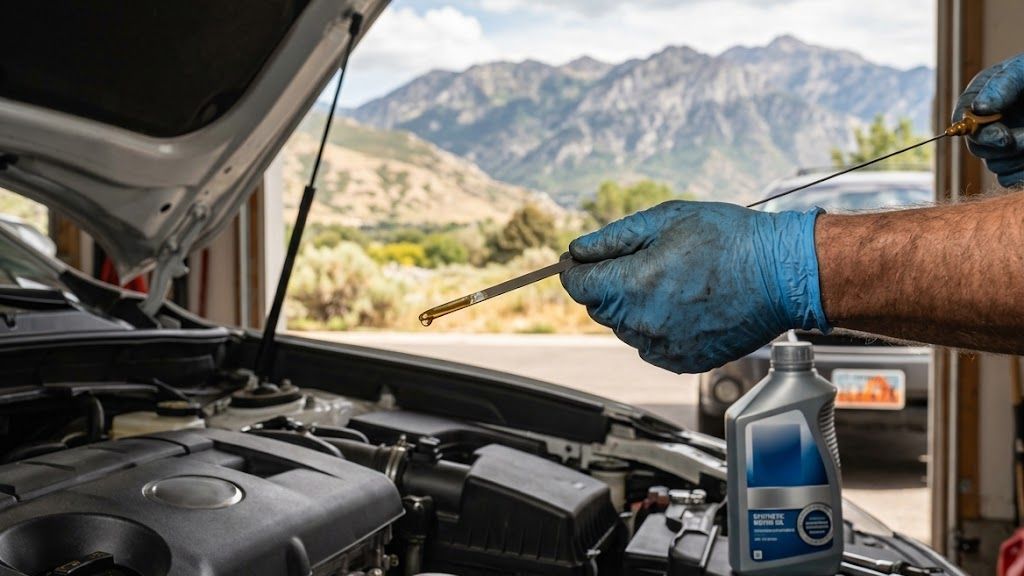
Terms like "lifetime fluid" deserve some skepticism. In practice that phrase means the expected life of the transmission under ideal laboratory conditions, and a nine-mile dirt climb at 8 percent grade is not an ideal condition. If you want a simple rule, check the fluid every spring and every fall. Bright red is fine, light brown means scheduled service soon, and dark or burnt means book an appointment now.
Driving Habits That Protect Your Transmission on Utah Canyon Roads
Small adjustments in how you drive the grades meaningfully extend the life of the drivetrain. None of these require special equipment, and all of them reduce peak fluid temperature:
- Drop out of overdrive on long climbs. Letting the engine lug at low RPM in top gear makes the torque converter slip more and generates far more heat than shifting down one gear.
- Use the tow or haul mode if your vehicle has one. It changes shift timing specifically to reduce hunting between gears on grades.
- Turn off the air conditioning if the temperature gauge starts climbing. The compressor adds load and the condenser pushes hot air straight across the cooling system.
- Pull over and idle in neutral for a few minutes if you smell anything burning. Idling circulates fluid through the cooler without adding load.
- Rinse the front of the radiator and cooler each spring. Bug debris and canyon dust restrict airflow more than most drivers expect.
- Never shift into park while rolling, and come to a complete stop before switching between drive and reverse.
If you are already noticing symptoms and are not sure whether the vehicle is safe to drive, contact us before your next canyon trip rather than after it, since a diagnosis costs a fraction of a tow. A short inspection can tell you whether you are looking at a fluid service or something structural.
When Is It Safe to Keep Driving, and When Should You Stop?
Judgment here depends on which symptom you have. Mildly rough shifting or a slightly delayed engagement usually means you can drive carefully to a shop. Active fluid loss, grinding noises, a burning smell, or a transmission temperature warning light means you should stop as soon as it is safe to do so.
The reason is simple. A transmission low on fluid loses both lubrication and cooling at once, and internal damage accelerates dramatically in a matter of miles. Drivers who push through a warning light routinely turn a repairable problem into a full replacement. When customers bring a vehicle to The Wizard Group at the first sign of slipping rather than after a breakdown on the shoulder of I-15, the repair is smaller, faster, and considerably less expensive nearly every time.
Frequently Asked Questions
Can you still drive a car with a slipping transmission?
You can, but you should not for long. Slipping means clutch surfaces are not holding, and every mile driven that way grinds away friction material and contaminates the fluid with debris. Short, gentle driving to reach a shop is reasonable. Commuting for weeks with a slip is how a $400 repair becomes a $4,000 one.
Will a fluid flush fix slipping gears?
Sometimes, and only if the fluid itself was the problem. If the slip is caused by low or degraded fluid, fresh fluid can restore proper hydraulic pressure and eliminate the symptom. If clutch packs are already worn or the valve body is damaged, a flush will not repair the mechanical wear. That is why diagnosis before service matters so much.
How much does transmission repair cost?
It varies widely by what actually failed. A fluid and filter service typically lands in the low hundreds, a solenoid or sensor replacement generally runs several hundred to just over a thousand, and a full rebuild or replacement commonly reaches several thousand depending on the vehicle. The spread is exactly why early diagnosis pays for itself.
How long does a transmission last if you drive mountain roads often?
A well-maintained automatic can comfortably exceed 200,000 miles, but sustained grades and towing shorten that meaningfully when fluid service is neglected. Vehicles driven regularly on steep terrain and serviced on a severe-duty schedule tend to perform close to their expected lifespan. Vehicles driven the same way with no fluid changes often show serious trouble well before 120,000 miles.
What does a burning smell from the transmission mean?
It means the fluid has overheated and started breaking down chemically. The odor is the fluid itself burning as it loses its lubricating properties, and it is one of the earliest reliable indicators of thermal damage. Treat it as urgent, let the vehicle cool, and have the fluid inspected before driving any further grades.
Conclusion
Mountain terrain is one of the best reasons to live in Davis County and one of the toughest environments a transmission can face. Slipping, delayed engagement, shuddering, burnt-smelling fluid, and warning lights are all your vehicle asking for attention, and every one of them is cheaper to address today than next month. Pair a severe-duty maintenance schedule with a few smarter habits on the grades, and most drivers will never see the inside of a rebuild.
If any of the symptoms in this article sound familiar, get the vehicle looked at before your next climb. Choosing auto repair services Bountiful, UT drivers already trust means starting with a real diagnosis, understanding exactly what failed and why, and leaving with a transmission ready for the next trip up the canyon.
Contact our team today.