Why Does My Camper Overheat Going Up Utah Mountain Grades?
You are halfway up a long climb outside Price, or grinding east out of Salt Lake City with a loaded trailer behind you, when the temperature needle starts drifting toward the red. That sinking feeling is one of the most common breakdowns travelers report in the Beehive State, and Utah road trip camper overheating almost always comes down to one simple reality: your cooling system is being asked to shed more heat than it can physically move while climbing a 6% grade at 7,000 feet. The good news is that the cause is usually a restricted radiator, a tired thermostat, low coolant, or a driving habit that works fine at sea level and falls apart on a sustained mountain pull. A full engine rebuild is rarely the answer.
Utah is unusually hard on cooling systems because the climbs are long, the elevation is high, and the summer air in the desert corridors is brutally hot. A truck that never blinked in Texas can run out of cooling margin on Soldier Summit. This guide explains exactly what is happening under your hood, how to tell normal heat from a genuine warning sign, what to do the moment the gauge climbs, and which components to inspect before you ever pull out of the driveway.
Is It Normal for the Coolant Temperature to Rise While Towing Uphill?
Yes, a rise is completely normal. Most modern gas and diesel trucks run somewhere between 195 and 220 degrees Fahrenheit under ordinary conditions, and a climb with a heavy camper behind you can push that reading 15 to 30 degrees higher without anything being wrong. Your engine is producing far more power on a grade than it does on flat ground, and every extra unit of power creates extra heat the radiator has to reject.
The question that matters is not whether the needle moves, but whether it moves and then stays put or keeps climbing. A towing uphill coolant temperature that rises to a new plateau and holds steady is a cooling system working at the top of its range but still in control. A temperature that climbs and never levels off is a system that has lost the fight, and that is when damage starts.
For context, a 50/50 antifreeze mix boils near 223 degrees at atmospheric pressure, but a healthy pressurized system with a good radiator cap raises that boiling point to roughly 260 degrees. This is exactly why a weak cap can turn an ordinary hot climb into a roadside failure. The margin you rely on is created by pressure, not by luck.
| Coolant Gauge Reading | What It Usually Means | What You Should Do |
|---|---|---|
| 195 to 220 F | Normal operating range, flat ground or light load | Nothing, keep driving |
| 220 to 235 F | Working hard on a grade, still within design limits | Back off speed, switch off the air conditioning, keep watching |
| 235 to 245 F | Cooling margin nearly gone, fans at full command | Downshift, slow to 40 to 45 mph, plan a pullout |
| Above 245 F | System has lost control, damage risk is real | Pull over safely and shut down, do not open the cap |
What Makes Utah Mountain Grades So Punishing on a Cooling System?
Utah combines three stressors that rarely show up together anywhere else in the country. Understanding them makes the difference between blaming your truck and correctly diagnosing the situation. Each one chips away at the same finite pool of cooling capacity.
Thin Air at Elevation
Air density drops roughly 3% for every 1,000 feet of elevation gain. At the top of Parleys Canyon near 7,050 feet, the air moving through your radiator carries far less mass, which means it carries away far less heat per cubic foot. Your naturally aspirated engine also loses power, so you press harder on the pedal to hold speed, which produces even more heat with even less ability to remove it.
Long, Sustained Climbs Instead of Short Hills
A short hill lets the cooling system recover on the far side. Utah does not offer that mercy. Spotted Wolf Pass on Interstate 70 gains almost 2,000 feet in about three miles, and the eastbound climb out of Salt Lake City through Parleys Canyon runs a sustained 6% grade, which is the steepest sustained grade allowed anywhere on the Interstate system. Twenty straight minutes at full throttle is a very different test than two minutes.
Desert Heat in the Summer Corridors
Ambient temperature sets the floor for everything your radiator can do. A radiator can only cool coolant down toward the temperature of the air passing through it, so a 105 degree afternoon near Green River leaves dramatically less usable temperature difference than a 70 degree morning. The same climb that feels routine at 7 a.m. can be a genuine problem by 3 p.m.
The Mechanical Causes Behind Utah Road Trip Camper Overheating
A camper that heats up on every climb, even a moderate one, is usually pointing at a specific failing component rather than at conditions. Once you have ruled out the driving side of the problem, the mechanical causes of the Utah road trip camper overheating fall into a short and predictable list, best worked through in order from airflow inward toward the pump. The items below reflect the failures technicians see most often on rigs that tow the western passes.
Clogged Radiator Fins and a Blocked Front Stack
This is the single most common cause and the easiest one to miss. Bugs, cottonwood fluff, road grime, and fine desert dust pack into the front of the cooling stack over thousands of miles and act like insulation. Clogged radiator fins can cut airflow enough to cost you 20 or 30 degrees of cooling capacity while everything else in the system tests perfectly fine.
Remember that your front stack is not just the radiator. On most tow vehicles the air conditioning condenser, transmission cooler, charge air cooler, and engine oil cooler are all stacked ahead of or behind it, sharing the same airflow. Debris trapped between the layers is invisible from the grille and is often only found by separating the coolers.
A Thermostat Stuck Partly Closed
A thermostat that opens fully at idle can still fail to open completely under load. The classic symptom is a truck that behaves normally around town and around your neighborhood, then heats up predictably on the first real grade. Because thermostats are inexpensive and easy to replace, they are worth changing on any rig with high mileage before a mountain trip.
Low Coolant, Old Coolant, or a Slow Leak
Coolant carries heat, so less coolant means less heat carried. Campers and tow vehicles are especially prone to slow leaks because hoses age, clamps loosen, and rigs often sit for months between trips. Old coolant also loses its corrosion inhibitors, which lets scale build inside the radiator tubes and quietly reduces heat transfer year after year.
Failing Water Pump or Fan Clutch
A water pump with eroded impeller vanes can circulate enough coolant at highway speed to seem fine, then fall short under the high heat load of a climb. A fan clutch is the other frequent offender, since a lazy clutch that fails to lock up robs you of exactly the airflow you need when road speed drops to 35 mph on a grade. If your fan never roars on a hot climb, that is a meaningful clue.
A Weak Radiator Cap
The radiator cap is a pressure regulator, and pressure is what keeps coolant liquid above its normal boiling point. A cap that has lost its spring tension bleeds pressure early, the coolant flashes to steam in the hottest passages, and steam does not transfer heat. It is a five dollar part that causes hundreds of dollars in diagnostic time.
Transmission Heat Loading the Same Radiator
On most tow vehicles the transmission cooler sits in the same front stack, so a transmission running hot dumps its heat into the same airflow the engine depends on. Transmission fluid also breaks down faster in extreme heat, which raises failure odds on a long uphill pull. This is precisely why so many overheating stories from Soldier Summit end in transmission repairs rather than engine repairs.
What Should You Do the Moment the Temperature Gauge Starts Climbing?
Act early, because an engine can be damaged in as little as 30 to 60 seconds of true overheating. The goal is to reduce heat production and increase heat rejection at the same time, and every step below does one or the other. Work through them in order.
- Turn off the air conditioning immediately. This removes a significant heat source from the front of your cooling stack and frees engine power.
- Reduce speed and reduce load. Slowing from 60 to 45 mph on a grade cuts engine output substantially and gives the radiator a chance to catch up.
- Downshift into a lower gear. Higher engine rpm spins the water pump and fan faster, which increases coolant flow and airflow at exactly the moment you need both.
- Turn the cabin heater on full blast. It is uncomfortable, but the heater core is a second radiator and it genuinely pulls heat out of the engine.
- Find a safe pullout and idle, do not shut off instantly. Idling with the hood up circulates coolant through the radiator and lets temperatures fall in a controlled way.
- Never open the radiator cap while the system is hot. Pressurized coolant above its boiling point will erupt the moment pressure is released.
If the temperature drops back to normal within a few minutes of pulling over and never returns during a gentle continued climb, you likely hit the edge of your cooling capacity rather than a broken part. If it climbs again quickly, stop driving and arrange service. Pushing on to the next town is how a cheap thermostat becomes a warped cylinder head.
How to Drive Utah Passes Without Cooking Your Engine
Technique matters as much as hardware on these roads. Most experienced haulers in the Intermountain West climb slower than the posted limit on purpose, because the fastest way up a grade is rarely the safest way for the drivetrain. A few habits protect the whole rig.
- Climb at a steady 45 to 55 mph rather than fighting to hold 65. Steady moderate load produces far less heat than repeated full throttle surges.
- Use tow/haul mode on every grade. It holds gears longer and keeps the engine in a range where the water pump and fan move real volume.
- Downshift before the climb, not partway up it. Entering a grade already in the right gear prevents the transmission from hunting under load.
- Start early in the day. Crossing Parleys, Soldier Summit, or the San Rafael Swell before 10 a.m. can mean a 30 degree cooler ambient temperature.
- Watch your mirrors and use pullouts. Slower speeds are safe only when you let faster traffic by, and pullouts double as cooling breaks.
- Descend in a low gear too. Engine braking saves your brakes, and brake fade on a 6% descent is every bit as dangerous as an overheated engine.
| Utah Grade | Approximate Elevation Change | What Towing Drivers Should Expect |
|---|---|---|
| Parleys Canyon, I-80 east of Salt Lake City | 4,920 ft to 7,050 ft | Sustained 6% grade with very few breaks, the classic overheating spot |
| Soldier Summit, US-6 | Climbs to roughly 7,477 ft | Long steady pull, common site of transmission and coolant failures |
| Spotted Wolf Pass, I-70 San Rafael Swell | About 2,000 ft in 3 miles | Short, steep, and remote with limited services in either direction |
| I-15 through the Cedar City corridor | Climbs past 6,000 ft | High summer heat combined with sustained elevation gain |
Preventive Maintenance to Handle Before You Leave the Driveway
Nearly every roadside cooling failure in Utah could have been caught in a driveway inspection an hour before departure. A pre-trip cooling system check takes less time than hitching the trailer and costs a fraction of a tow bill from a canyon with no cell service. Build the following into your routine before any mountain trip.
- Rinse the front stack gently with a garden hose from the engine side outward, never with a pressure washer, since high pressure bends the delicate aluminum fins and makes the problem worse.
- Check coolant level cold, at both the reservoir and the radiator, and top off with the correct specification for your engine rather than whatever is on the shelf.
- Pressure tests the system to find slow leaks that only show up under load, and replace the radiator cap if it fails to hold its rated pressure.
- Inspect hoses for softness, swelling, or cracking near the clamps, since a hose that feels mushy when squeezed is already on its way out.
- Confirm the fan clutch engages by listening for the fan to roar during a hot idle, and confirm the electric fans cycle on a warm engine.
- Change transmission fluid if it is dark or smells burnt, because fluid condition directly affects how much heat the trans dumps into your radiator.
- Service your camper's own components too, including tire pressure and bearing grease, since a dragging brake or underinflated tire adds real load to every climb.
The teams at
The Wizard Group see the same short list of failures over and over on rigs that limp into the shop after a canyon climb, and most of them were visible weeks earlier as a soft hose, a crusty radiator face, or coolant that had not been changed in six years. A proper pre-trip cooling inspection is the highest value hour of maintenance a traveler can buy before heading into the mountains.
When Should You Stop Guessing and Get a Professional Diagnosis?
If your rig overheats on every grade regardless of speed, ambient temperature, or air conditioning use, the problem is mechanical and no driving technique will hide it. The same is true if you are losing coolant with no visible puddle, seeing white smoke from the exhaust, or finding a milky film on the oil cap, all of which can point toward a head gasket rather than a cooling accessory.
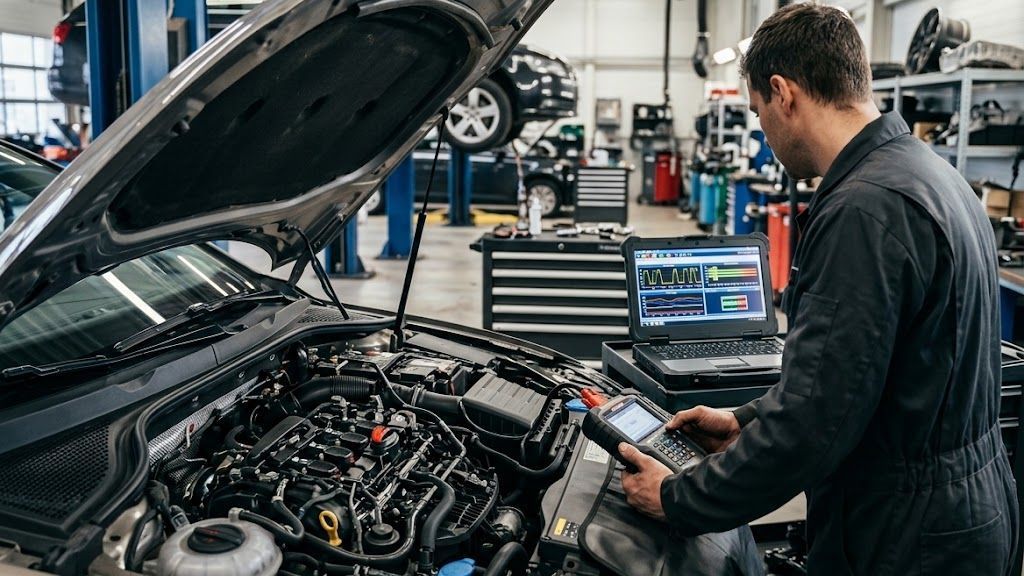
Diagnosis matters because the symptoms overlap so heavily. A stuck thermostat, a weak water pump, a lazy fan clutch, and clogged radiator fins can all produce an identical gauge reading, and replacing parts one at a time is an expensive way to guess. A shop with a pressure tester, an infrared thermometer, and a scan tool can separate them in an afternoon. Travelers who want that work done properly can contact us to schedule a cooling system inspection before the next trip rather than after the next breakdown.
Timing matters as well. A diagnosis scheduled in spring gives you room to order a radiator or a fan clutch and still leave on schedule, while the same diagnosis in July often means waiting on parts during peak travel season. Booking a cooling inspection with The Wizard Group ahead of your departure window is simply cheaper and less stressful than sorting it out from a canyon pullout.
The Wizard Group works on cooling systems for travelers who actually use their campers in the mountains, which is a different standard than a rig that only ever sees flat interstate. The difference shows up in the details, including whether the front stack was separated and cleaned, whether the fan clutch was tested under real load, and whether the transmission cooler was evaluated alongside the radiator instead of ignored.
Frequently Asked Questions
How hot is too hot for a truck towing a camper?
Anything up to about 235 degrees Fahrenheit is generally acceptable under heavy load on a grade, as long as the reading stabilizes rather than continuing to climb. Above 245 degrees you are past the safety margin of most factory systems and should pull over. The exact threshold varies by manufacturer, so check the owner's manual for your specific engine.
Can high altitude alone cause my camper to overheat?
Altitude alone rarely causes overheating in a healthy system, but it removes the safety margin that hides small problems. Thinner air cools less effectively and forces the engine to work harder for the same speed, so a marginal thermostat or a dirty radiator that never caused trouble at sea level will surface at 7,000 feet. Altitude is usually the trigger, not the root cause.
Should I turn the heater on if my engine starts overheating?
Yes, running the cabin heater at full temperature and full fan speed is a legitimate emergency measure. The heater core is essentially a small second radiator, so it pulls heat out of the engine and dumps it into the cabin. It is uncomfortable on a hot Utah afternoon, but it can buy you the few minutes you need to reach a safe pullout.
How often should I clean my radiator if I tow regularly?
A visual inspection before every trip and a gentle rinse at least once per towing season is a reasonable baseline. If you drive through cottonwood, insect swarms, or dusty backroads, inspect more often, because a single heavy bug run can measurably restrict airflow. Always rinse from the engine side outward so debris exits the way it came in.
Is it safe to keep driving to the next town if the temperature comes back down?
Only if the temperature returns to normal on its own and stays normal during a gentle continued climb. If it spikes a second time, the system has an actual fault and continued driving risks warped heads, a blown head gasket, or a seized engine. Repeated overheating cycles cause cumulative damage even when the engine still runs afterward.
Conclusion
Most Utah road trip camper overheating is a story about margin rather than a story about failure. Thin air, sustained 6% grades, and desert heat strip away the reserve capacity your cooling system relies on, and whatever weak link you were carrying, whether a tired thermostat, a slow coolant leak, or clogged radiator fins, is what finally shows up on the gauge halfway up the pass. Fix the weak link and drive with the terrain instead of against it, and the same climb becomes uneventful.
Slow down on the climbs, use tow/haul mode, start your driving day early, and treat a rising gauge as information rather than an inconvenience. Pair that with an honest pre-trip inspection of the radiator, cap, hoses, fan clutch, and coolant condition, and you remove nearly every common cause before it can strand you. Utah's mountain roads are some of the most rewarding towing in the country, and they are entirely manageable for a rig that arrives prepared.